New Media Unlocked!
You can now publish on USA TODAY through MarketersMEDIA. That's 142M+ monthly visitors and DR 92 backlinks for every release you publish.
Better reach, better SEO, better credibility.

You can now publish on USA TODAY through MarketersMEDIA. That's 142M+ monthly visitors and DR 92 backlinks for every release you publish.
Better reach, better SEO, better credibility.
Table of Content


Public Relations, or PR, is about how your brand is understood by people who do not work for you.
That includes:

If you strip it down to the basics, PR is about managing relationships at scale.
It is about shaping how information about your brand flows into the world, and how people interpret that information when they see it.
It is important because people rarely experience your brand only through your website or your ads. They experience it through search results, news articles, social media posts, reviews, and word of mouth.
Hence, PR is the discipline that connects all of those touchpoints into one consistent story.
Public Relations, or PR, is the practice of managing how information about your brand is shared with the public and how that information shapes perception over time.
PR touches things like:
PR is an ongoing process of making sure your brand is understood in the way you intend it to be understood.
One of the easiest ways to understand PR is to compare it with advertising and marketing:
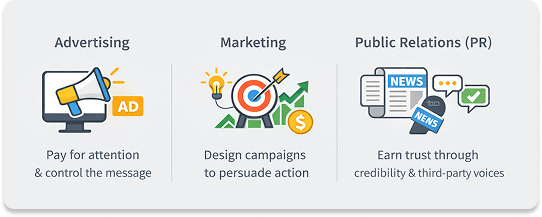
This difference matters because people are more likely to believe other people than they are to believe a brand talking about itself.
When a company says its product is great, most readers automatically treat that as promotion (advertising or marketing).
But, when a publication, an industry site, or a journalist says the same thing, it carries more weight, simply because it comes from the outside. The source changes how the message is received. That is where PR gets its real value.
Good PR usually does not feel like advertising at all. It feels like information someone would want to read anyway, whether they plan to buy something or not.
PR is also not about hiding problems or trying to make bad news disappear.
In practice, some of the most important PR work happens when things go wrong. The way a company explains what happened, what it is doing next, and how it takes responsibility often stays in people’s minds much longer than any product launch or campaign.
PR is not one single activity.
It is a group of related practices that all serve the same goal, which is to manage perception and communication. Different companies focus on different areas depending on their size, industry, and goals.
The most common areas include:
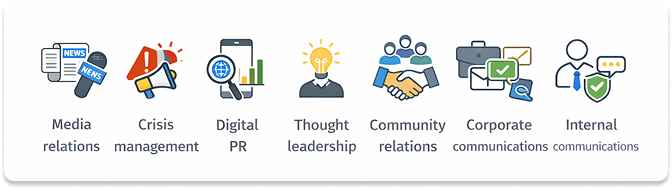
Each of these plays a different role, but they all connect back to the same core idea. They shape how your brand is seen, talked about, and trusted.
Media relations is about working with journalists and editors so your company is covered accurately and in the right context.
It means understanding what different publications focus on, what their audiences care about, and when your story is relevant to them.
Over time, this helps your brand become a trusted source that journalists recognize and return to for information.
Crisis management is about how a company communicates when something goes wrong.
This includes:
Clear and timely communication during difficult moments helps protect trust and reduces long-term damage to the brand’s reputation.
Digital PR focuses on earning online coverage that improves both visibility and credibility. This includes mentions on news sites, blogs, and industry platforms that people actually read.
When done consistently, digital PR helps more people discover your brand and strengthens how your company appears in search results.
The story was also picked up by multiple news and industry sites, introducing the expansion to new audiences, reinforcing the airline’s international presence, and creating lasting online mentions that continue to appear in search results.
Want your brand story featured on credible media outlets?
MarketersMEDIA Newswire helps you get the kind of third-party visibility these big brands achieved—through press release distribution to established publications. Get in touch with us today.
Thought leadership is about positioning your company or its leaders as reliable voices in your industry.
This can happen through articles, interviews, or expert commentary. The goal is to share useful insights that show your experience and understanding, which builds trust over time.
Community relations is about how your brand engages with the groups and communities around it.
This can include local involvement, partnerships, or supporting relevant initiatives.
Strong community relations help your company be seen as a responsible and active participant, not just a business that sells something.
Corporate communications covers how a company shares important information with investors, partners, and the public.
For examples:
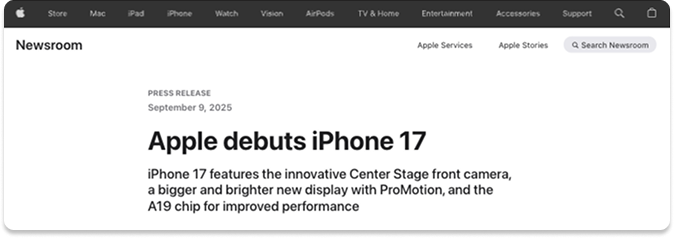
This includes major announcements, company updates, and strategic changes. Clear corporate communication helps your business appear stable, organized, and credible.
Internal communications is about keeping employees informed and aligned with what the company is doing and why.
When teams understand the company’s direction and messages, they are more likely to represent the brand consistently and confidently outside the organization.
For example, when a company is about to launch a new product or enter a new market, it shares a clear internal briefing with employees explaining the plan, the key messages, and what customers might ask.
This helps sales, support, and marketing teams give consistent answers and present the company’s story in the same way when they speak to customers or partners.
People today are cautious. They research before they buy. They compare options. They read reviews and articles. They look for signals that a brand is legitimate and reliable.
PR creates those signals.
When your company is mentioned by credible publications such as Business Insider, Yahoo! News and AP News, or quoted as a source, it changes how people see you.
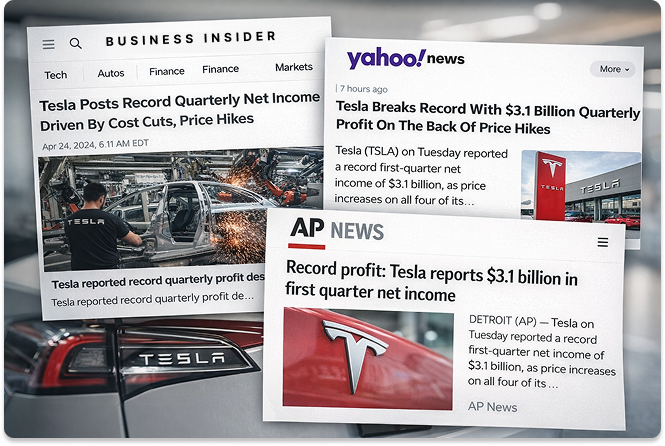
It tells them that you are a business that others consider worth paying attention to.
This kind of trust cannot be switched on overnight.
It is built gradually, through consistent and visible presence in the right places. The important part is that this trust exists before the customer is ready to buy.
By the time they reach your website or your sales team, their opinion has already been shaped by what they have seen elsewhere.
Every brand ends up being associated with certain ideas, whether it plans for it or not. If a company does not consistently communicate what it wants to be known for, people will decide that based on whatever they see most often.
PR helps reinforce those associations by repeatedly putting the same themes, messages, and stories in front of the public over time.
For example, when people talk about Apple, most people think about the iPhone, product launches, and design. That did not happen by accident.
Over many years, Apple has consistently shared stories, announcements, and media coverage around its products and innovation. As a result, those ideas became what people naturally associate with the brand.
When someone hears your company name for the first time, they will almost always connect it to whatever they have seen or read about you before.
PR helps make sure those connections are built around the things you actually want to be known for, not random or one-off mentions.
Your reputation is one of your most valuable assets, and it is also one of the most fragile. It takes years to build and minutes to damage.
When something goes wrong, silence usually makes things worse. Reacting without thinking can do just as much harm. This is where PR becomes critical.
PR provides a framework for responding in a way that is calm, clear, and responsible. It helps you acknowledge problems, explain what you are doing about them, and keep people informed without making promises you cannot keep.
Brands that handle crises well often come out stronger, not because the problem never happened, but because people saw how the company behaved under pressure.
That behavior is part of your public story, and PR is what helps you manage it.
Advertising is powerful, but it is temporary. The moment you stop paying, the visibility stops.
PR works differently. A good article, interview, or feature can keep bringing attention to your brand for months or even years.
It can appear in search results, be shared on social media, and be referenced by other writers. Each piece of coverage becomes another door through which people can discover you.
Over time, this creates a network of visibility that does not disappear when a campaign ends. It compounds. The more credible coverage you earn, the easier it becomes to be seen as established and trustworthy.
If your goal is to attract investors, PR helps build a story of credibility and momentum.
If your goal is to hire better talent, PR helps create an employer brand that people want to be associated with.
If your goal is to enter a new market, PR helps you look established faster than you would on your own.
For example, when ORLEN announced its expansion the coverage helped introduce the brand to new audiences and position the move as a serious, credible business step rather than a quiet or uncertain experiment.
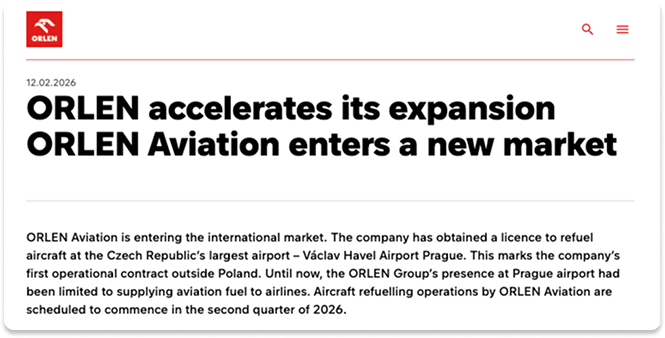
Most buying decisions today begin with research. Long before someone fills out a form or talks to sales, they have already formed an opinion based on what they have seen and read.
PR influences that research phase, which means it influences decisions long before they become visible in your pipeline.
PR shapes how people discover your brand, how they judge it, and how they remember it. But these outcomes do not come from tools or tactics alone.
They come from the way PR is practiced. To make PR work in the real world, certain skills matter far more than others.
PR has changed a lot over the years. It is no longer just about writing press releases and counting how many times your company is mentioned. The skill set has expanded because the media environment has expanded.
Strong writing is still the foundation of good PR.
Clear, simple communication matters in press releases, statements, articles, and pitches. If you cannot explain something well, everything else becomes harder.
Good writing makes complex ideas easier to understand and helps your message travel accurately from your company to the public.
One of the easiest ways to get this right is to start with a clear press release template, so you can focus on the message instead of worrying about the structure.
Free Press Release Template
Get your free copy of press release template and advanced PR guide to run your press release.

Media understanding is about knowing how journalists work, what they need, and what makes a story useful to their audience.
PR is built on relationships, not just distribution.
When you understand how the media thinks, you can share information in a way that is more likely to be used and understood correctly.
Good PR is about knowing when to speak, where to speak, and what actually adds value to the conversation.
That starts with research.
You need to understand your industry, your audience, and what is already being talked about before you decide what to say.
This means looking at what journalists are covering, what questions customers are asking, and what topics are already crowded or overused.
With that context, you can shape your message so it fits the moment and the platform, instead of repeating something generic.
Doing this well helps your brand show up in the right places with the right message. It makes your communication feel relevant and useful, rather than like more noise in an already busy news cycle.
Crisis thinking is about staying calm and structured under pressure. An organization needs to be responsible, clear, and consistent when the stakes are high.
This skill helps companies respond in a way that protects trust instead of making a difficult situation worse.
Digital literacy is the ability to understand how information spreads online and how people discover content through:
When you understand how online visibility works, you can plan PR in a way that lasts longer than a single news cycle.
For example, you can think about how an article might rank in search, how a headline might be shared, or how a mention might drive traffic back to your site.
This turns media coverage into something that keeps working over time, instead of something that disappears after a day or two.
Digital literacy also helps you connect PR to real business outcomes. Instead of seeing coverage only as awareness, you can see how it supports discoverability, meaning how easily people can find your brand when they search, research, or compare options online.
Analytical thinking is important in PR because it helps you understand what is actually working and what is not.
Instead of focusing only on surface-level numbers like impressions or raw mention counts, it pushes you to look at signals that show real impact.
This includes things like whether more people are searching for your brand, how often you are mentioned compared to competitors, and whether the coverage you get comes from credible and relevant sources.
You can also look at what happens after people see that coverage, such as whether they visit your website, sign up, or start a sales conversation.
By looking at PR this way, it becomes easier to improve over time.
All of these skills shape how effective your PR efforts really are. But skills alone are not enough. You also need practical ways to get your news in front of the right audiences at the right time.
That is where press releases and distribution come in, but…
Yes, press release distribution is still effective for PR, but only when it is used the right way as follows:
The announcement should be something people outside your company would actually care about, not just a promotional update.
The content should be easy to understand and helpful to journalists and readers, not filled with vague or sales-heavy language.
The release should support your overall PR strategy, not exist as a one-off announcement with no follow-up or context.
A well written press release creates a clear public record of your announcement. It gives journalists and publishers a reliable source of information, and it makes your news easier to find, reference, and share.
Distribution platforms like MarketersMEDIA Newswire make this process more efficient by helping your releases reach a wide network of media outlets and news sites.
PR works because it shapes how people meet your brand long before they are ready to buy, invest, or partner with you.
It shows up in search results, in articles, in conversations, and in the context people use to judge whether you are credible or not.
This is why PR is not something you run once and move on from.
It is something you build into how your company communicates over time. The companies that benefit most from PR are not the ones chasing attention. They are the ones consistently sharing clear, useful, and relevant stories.
Over time, that consistency does something simple but powerful. It reduces doubt. It makes decisions easier for customers.
And it makes your brand feel familiar before anyone ever lands on your website, through everything from media coverage to day-to-day PR communication.
A: PR is a long-term strategy, not an instant traffic switch. Some results, like coverage from a timely announcement, can appear within days or weeks. Bigger outcomes, such as stronger brand trust, higher brand search volume, and consistent media presence, usually take months of steady effort. The timeline depends on how often you share news, how strong your stories are, and how competitive your industry is.
A: No. Many effective PR campaigns are built around smaller but relevant stories. Examples include product updates, data insights, partnerships, customer milestones, industry commentary, or trend reports. Journalists and readers care more about relevance and usefulness than about size. A small but well-framed story can perform better than a big but generic announcement.
A: PR focuses on earning attention from third parties such as media outlets, journalists, and industry platforms. Content marketing focuses on content you publish on your own channels, such as your blog, email list, or social media. In practice, they work best together. Your content can support PR pitches, and PR coverage can bring new audiences to your content.
A: Yes, and often more than large brands. Smaller companies usually have less brand recognition, which means trust is harder to earn. PR helps close that gap by borrowing credibility from media coverage, industry mentions, and third-party validation. Even a few strong placements can make a young company look more established and more trustworthy.
A: PR can be scaled to your budget. It can range from doing your own outreach and press releases to working with agencies or using distribution platforms. The real cost is usually time and consistency, not just money. What matters most is having clear stories, clear messaging, and a realistic plan you can maintain.


 PR playbook to get your brand cited in AI answer
How to check and fix what AI says about your brand
2 minutes checklist to make your PR AI-friendly
PR playbook to get your brand cited in AI answer
How to check and fix what AI says about your brand
2 minutes checklist to make your PR AI-friendly