New Media Unlocked!
You can now publish on USA TODAY through MarketersMEDIA. That's 142M+ monthly visitors and DR 92 backlinks for every release you publish.
Better reach, better SEO, better credibility.

You can now publish on USA TODAY through MarketersMEDIA. That's 142M+ monthly visitors and DR 92 backlinks for every release you publish.
Better reach, better SEO, better credibility.
Table of Content


In public markets, perception influences valuation as much as performance.
Financial results matter, but so does how those results are communicated, interpreted, and understood by investors.
This is where investor relations play a central role.
Yet many companies think about investor relations only when something goes wrong. A stock drop. A failed IPO. An analyst downgrade. By then, the damage is already done.

Investor relations actually goes far beyond writing earnings reports or fielding calls from shareholders. It is the strategic function that shapes how the market understands your company, what value it assigns to your shares, and whether investors trust the people running it.
Investor relations (IR) is the strategic management function responsible for communication between a publicly traded company and the financial community.
That includes institutional investors, retail shareholders, equity analysts, regulators, and the broader financial press.
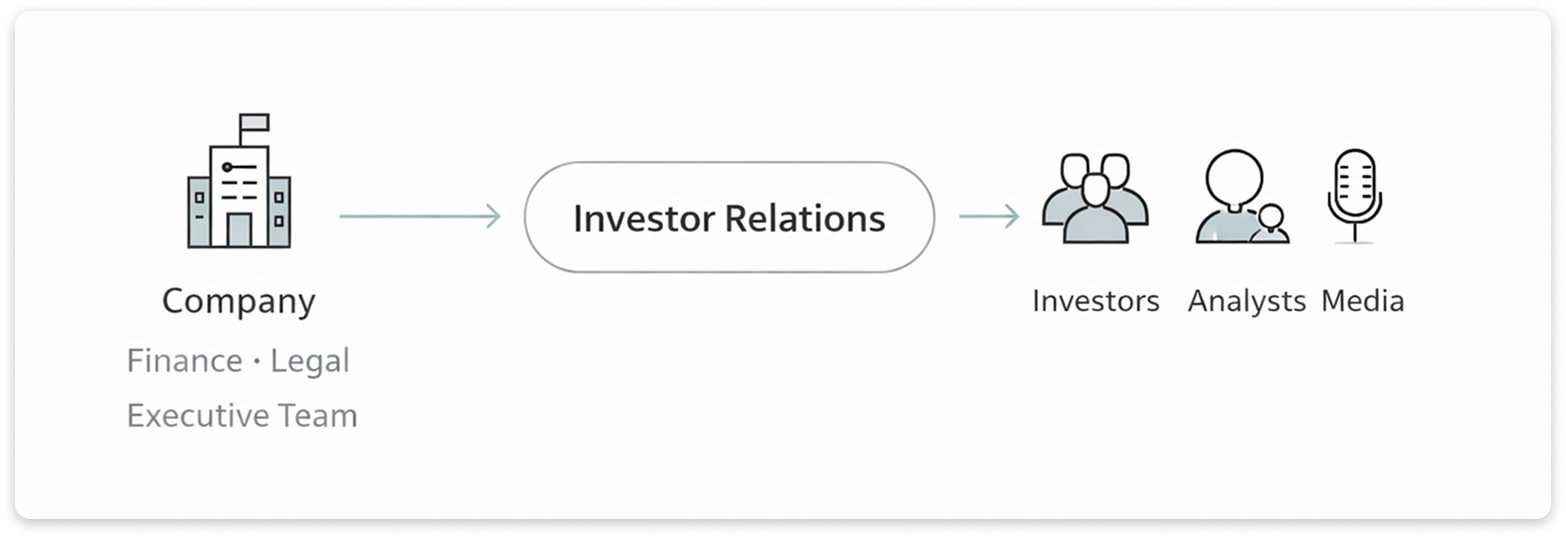
IR exists to help your company’s securities achieve a fair market value. Not an inflated value. Not a depressed one. A fair one, based on accurate, timely, and transparent information.
IR sits at the intersection of corporate finance, marketing, legal compliance, and communication. That combination makes it distinct from general public relations, which focuses primarily on brand image and media coverage.
Both IR and PR are communication functions, but they serve different audiences with different expectations.
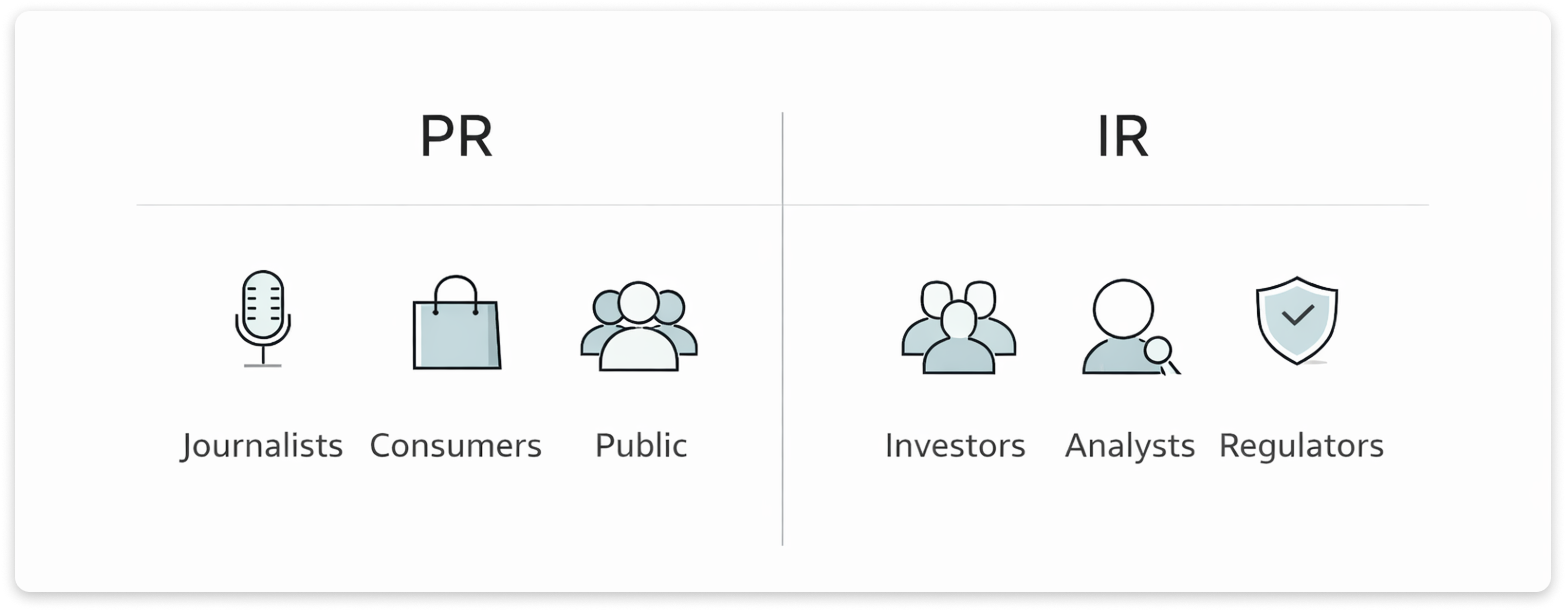
P.S. Regulators are government-authorized agencies or bodies responsible for setting, monitoring, and enforcing rules, standards, and policies within specific industries or sectors. They exist to ensure market fairness, protect consumers from fraud, ensure safety, and maintain stability, often through licensing, supervision, and penalties.
PR can be persuasive and storytelling-focused. As for IR, it has to be factual, legally compliant, and consistent across every channel.
A quote in a press release and a line in an SEC filing need to say the same thing. That level of discipline is what separates the two functions.
Three regulatory frameworks shape how investor relations are practiced for public companies.
It was introduced following major accounting scandals.
It requires accurate and frequent financial reporting and gives investors direct access to financial records. IR professionals operate inside the compliance structure SOX created.
This regulatory foundation is equally important. It prohibits selective disclosure, meaning a company cannot share material non-public information with a select group of analysts or investors before making it available to everyone simultaneously.
Violating Regulation FD can lead to enforcement action by the U.S. Securities and Exchange Commission, including:
Beyond regulatory fines, selective disclosure can damage investor trust, trigger stock price volatility, and increase the risk of shareholder lawsuits.
In serious cases, individuals may face personal liability, and the company may be subject to heightened regulatory scrutiny and stricter disclosure controls going forward.
ESG reporting is the newest layer of regulatory pressure.
Environmental, Social, and Governance disclosures are moving from voluntary to mandatory, particularly with the SEC’s climate disclosure rules and California’s SB 253.
IR teams are increasingly responsible for ensuring that ESG data meets the same audit-level rigor as financial reporting.
An IPO (Initial Public Offering) is when a private company sells its shares to the public for the first time and becomes listed on a stock exchange. This is how a company “goes public.”
A SPAC (Special Purpose Acquisition Company) is a publicly traded shell company created specifically to merge with a private company. When the merger happens, the private company effectively becomes public without going through a traditional IPO process.
M&A (Mergers and Acquisitions) refers to one company merging with or buying another company. These transactions can significantly impact ownership, valuation, and future strategy.
All three events represent major structural changes for a company, especially when public investors are involved.
That is why investor relations play a critical role during these phases.
It is the baseline.
Investors evaluating a pre-IPO company or an M&A deal need complete, accurate information to make decisions.
Any gap in disclosure creates doubt, and doubt drives down valuations.
Compliance during these transactions is complex.
IR professionals work alongside legal counsel to ensure that every disclosure meets timing requirements and regulatory standards.
The disclosure timelines matter: information that affects stock prices requires immediate disclosure, while general supporting information can be released within 7 to 14 days.
It is harder than it sounds when multiple parties are involved.
During an M&A deal, employees, shareholders, regulators, and the press all need to hear a unified story. IR manages that consistency before conflicting narratives create confusion.
It is to build good relationships with new shareholders and analysts is a long-term investment.
IR professionals who streamline the onboarding of new investors post-IPO reduce churn in the shareholder base and build the kind of institutional support that stabilizes share price during volatility.
IR does not only protect valuations during SPACs, IPOs, or M&A activity.
It also plays a central role in supporting company leadership and shaping how the market interprets every major development that follows.
The CEO and CFO are the public face of a company’s investor relations program. But behind them, IR professionals do the work that makes those interactions credible and effective.

When analysts or institutional investors request additional information, the IR team coordinates responses across finance, legal, and operations.
During M&A due diligence, that coordination becomes especially demanding. A well-prepared IR team reduces friction and keeps deals on track.
Management teams are often too close to operations to read market signals clearly.
IR professionals monitor analyst sentiment, track shareholder base composition, and identify when market perception is diverging from company fundamentals.
They bring that intelligence back to the executive team so leadership can respond strategically rather than reactively.
Every company needs a clear, consistent story for investors that does not use marketing language, but a substantive explanation of the business model, competitive position, and path to value creation.
IR professionals develop and maintain that narrative, ensuring it holds up across earnings calls, investor conferences, and one-on-one meetings.
Earnings releases, valuation gaps, strategic pivots, and negative news cycles all require careful, well-timed communication.
IR professionals draft the language, prepare executives for Q&A, and ensure that every response stays within legal boundaries while still giving investors the information they need.
A bad earnings call is not just an uncomfortable 45 minutes.
It can create lasting doubts about management credibility. The preparation that IR teams put in before these events is what separates companies that recover quickly from those that spend quarters trying to rebuild confidence.
Want your brand story featured on credible media outlets?
MarketersMEDIA Newswire helps you get the kind of third-party visibility these big brands achieved—through press release distribution to established publications. Get in touch with us today.
The expectations placed on IR teams in recent years are significantly higher than they were a decade ago.
One of the reasons is because AI-powered research tools now allow analysts to process hundreds of pages of financial filings in seconds.
They compare ESG disclosures across competitors, identify changes in forward-looking language between quarters, and flag inconsistencies in real time.
Structured reporting through Inline XBRL has made financial data machine-readable.
That is a positive development for efficient markets, but it also means there is nowhere to hide if numbers are inconsistently presented across different filings.
Social media adds another layer of complexity.
Statements made by executives on LinkedIn or in podcast interviews are now compared against SEC filings by automated tools.
IR teams that do not treat every public statement as part of the disclosure record are taking unnecessary risk.
The companies that manage this environment best treat their IR website as a primary source of truth, update it consistently, and ensure that messaging is synchronized across every channel before it goes out.
In a digital and AI-driven market, investor relations has become more visible and more accountable.
The individuals leading IR must now balance compliance, analytics, communication, and executive advisory responsibilities simultaneously.
So today, an IR professional needs to operate at a higher level than ever before.
The right IR professional brings a specific combination of skills that most individual functions do not require together.
IR professionals need to understand corporate finance, read financial statements with precision, and build financial models.
They need to know what numbers are material, what guidance is supportable, and what comparisons analysts are likely to make.
It is important because IR is increasingly a quantitative function.
Tracking relative stock performance, shareholder base composition, and analyst estimate accuracy all require comfort with data.

IR professionals have to present complex financial information clearly, both in written materials and in live settings.
This includes the ability to handle difficult questions from sophisticated investors without giving away information that should not be disclosed.
It is what keeps companies out of regulatory trouble.
The difference between accurate disclosure and selective disclosure is sometimes a single sentence. IR professionals who move fast and cut corners create legal exposure for the companies they serve.
Compliance and regulatory considerations refer to the legal rules public companies must follow when communicating with investors.
These requirements are important because violations can lead to fines, lawsuits, and damage to investor trust. In public markets, credibility is closely tied to consistent and lawful disclosure.
These rules are set by regulators to ensure fairness, transparency, and equal access to information. They apply to executives, investor relations teams, and anyone involved in sharing financial or strategic updates with the public.
It prevents companies from selectively sharing important non-public information with certain analysts or investors.
If material information is accidentally disclosed to one party, it must be promptly made public to everyone.
Executives and employees cannot trade company shares during certain periods, especially around earnings announcements.
These blackout periods help prevent unfair advantage. IR teams are responsible for enforcing these rules and ensuring employees understand when trading is restricted.
When companies provide forecasts or projections, they must include proper legal disclaimers known as safe harbor language.
This reduces legal risk if actual results differ from expectations.
To manage these risks, companies put structured systems in place. Important disclosures are reviewed by legal teams. Some organizations form disclosure committees to approve major communications.
Clear internal policies define who can speak publicly, what can be said, and when it can be said. Without these safeguards, even small communication mistakes can create serious regulatory problems.
Regulatory compliance is the baseline requirement of investor communication.
However, meeting the rules alone does not build investor confidence. In today’s market environment, companies must communicate strategically, transparently, and consistently.
The companies with the strongest investor relations programs share a consistent set of practices:
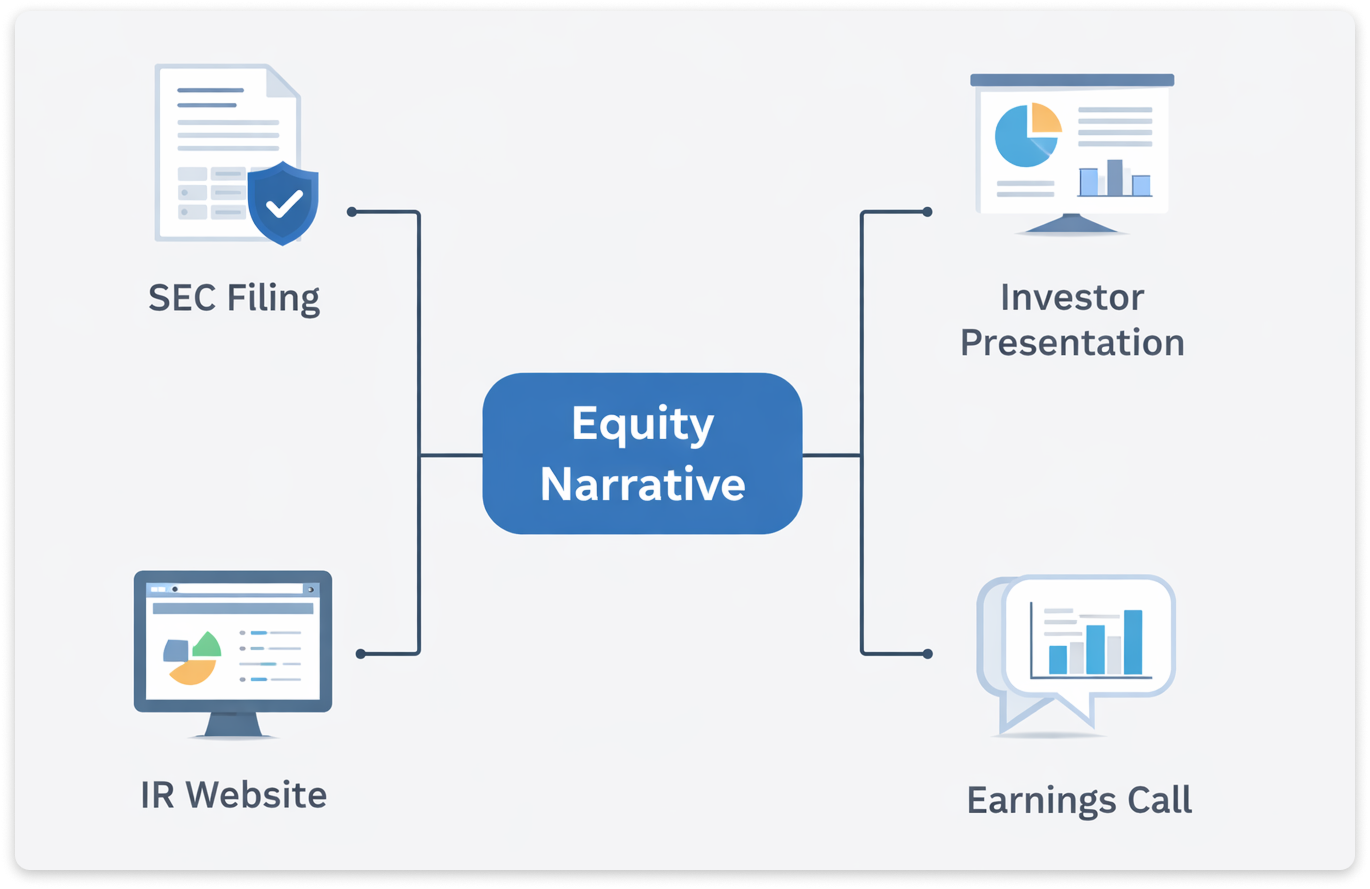
Every touchpoint, including SEC filings, investor presentations, the IR website, and executive interviews, should reinforce the same strategic story.
When messaging drifts between channels, investors notice, and valuation gaps can emerge.
When analyst models diverge significantly from company guidance, it signals a communication disconnect.
Addressing that gap requires proactive engagement rather than waiting for the next earnings cycle.
For many investors, the IR website is the first evaluation point.
Outdated filings, missing transcripts, or incomplete executive bios suggest that investor communication is not a priority.
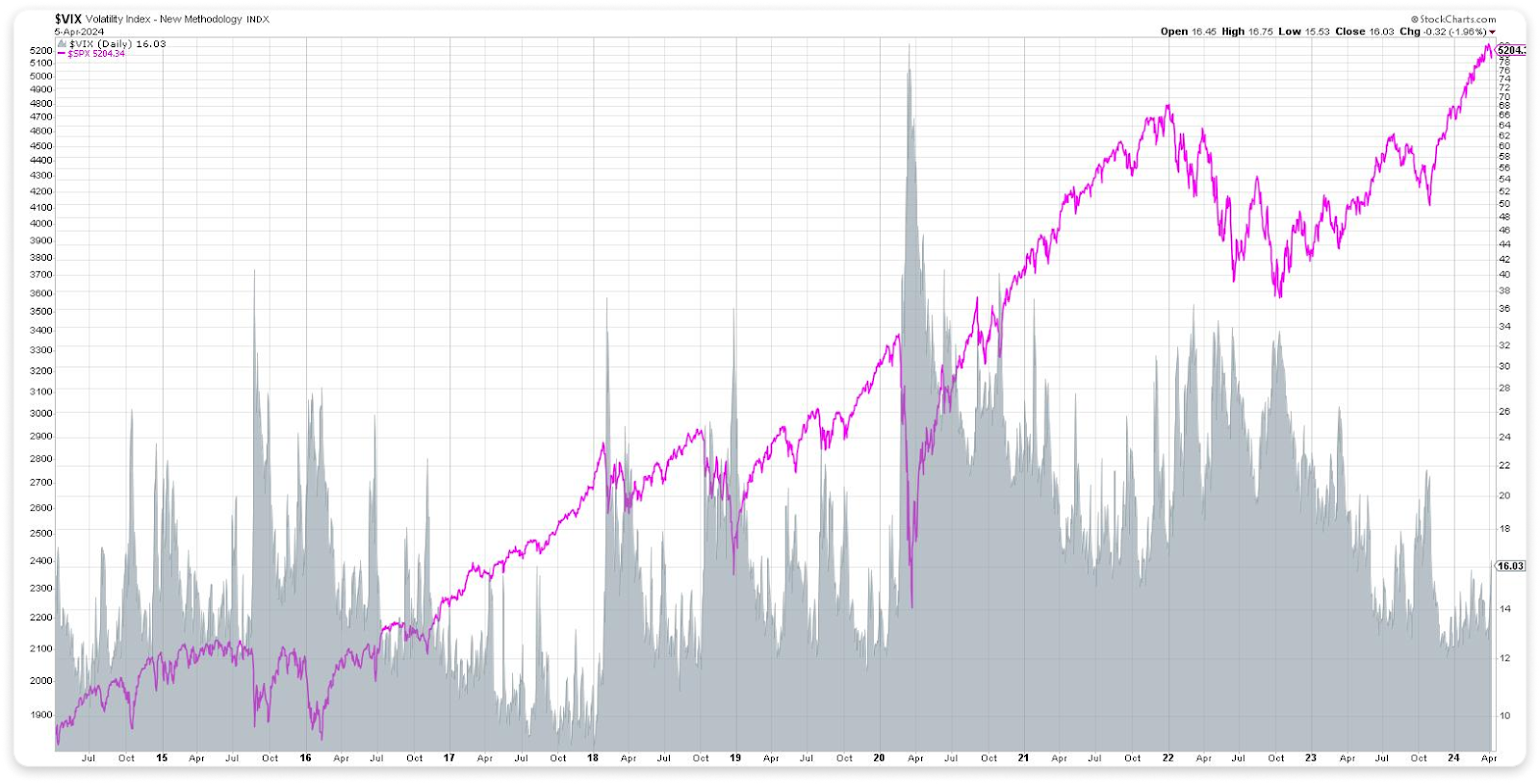
Stock price movement alone does not tell the full story.
You need to analyze how analysts and investors interpret earnings commentary to help refine future messaging and clarify misunderstood points.
As ESG reporting becomes more standardized and closely examined, companies that treat it purely as a reporting obligation risk credibility issues.
Institutional investors increasingly expect ESG communication to connect clearly to long-term value creation.
Companies that execute these best practices consistently reduce uncertainty in the market.
And in capital markets, reduced uncertainty translates directly into stronger trust and more stable investor relationships.
Strong IR programs do more than share information. They build sustained investor confidence through transparency, consistency, and proactive engagement.
Transparency is the foundation of investor trust. Investors do not expect companies to deliver perfect results every quarter. They expect clarity, honesty, and timely disclosure.
When negative developments are communicated early, with context and a clear explanation of next steps, the market can absorb the information rationally. Attempting to soften, delay, or obscure bad news may protect short-term optics, but it often damages long-term credibility.
Over time, companies that are consistently transparent build reputations for reliability. That reputation becomes a stabilizing force during periods of uncertainty.
Trust compounds when messaging remains stable across time and channels.
If earnings guidance aligns with prior statements, if executive interviews reinforce the same strategic priorities found in filings, and if quarterly updates follow a coherent narrative, analysts gain confidence in management discipline.
Inconsistent messaging, shifting priorities, or unexplained changes in tone create uncertainty.
In capital markets, uncertainty often translates into valuation discounts. Consistency reduces that uncertainty and strengthens confidence in leadership execution.
Investor trust is strengthened when companies communicate regularly, not only when required.
Providing updates outside formal reporting cycles, such as strategic milestones, operational developments, or market context, reduces speculation.
When investors already understand the company’s direction and risk exposure, unexpected news is less likely to trigger sharp market reactions.
Proactive engagement shifts communication from reactive damage control to steady expectation management.
Institutional investors rely on structured, comparable, and accessible information to make allocation decisions.
Clear earnings materials, detailed investor presentations, accessible transcripts, and well-organized ESG reporting allow long-term investors to evaluate performance beyond short-term price movements.
When disclosures are thorough and strategically aligned, they attract investors who focus on fundamentals rather than short-term trading dynamics.
This supports a more stable shareholder base and, over time, stronger long-term valuation support.
Building investor trust requires more than intent. It requires consistent distribution, visibility, and controlled messaging across the right channels.
This is where press release distribution platforms play a supporting role.
Free Press Release Template
Get your free copy of press release template and advanced PR guide to run your press release.

Press releases are a core IR tool, and distribution matters. When a company issues material news, whether it is a quarterly earnings release, an executive appointment, or a strategic partnership, that information needs to reach the right audiences quickly and through credible channels.
At MarketersMEDIA Newswire, we help companies distribute press releases to over 2,000 media endpoints, including Business Insider, Yahoo Finance, and AP News.
For IR teams managing time-sensitive disclosures, speed and placement quality are not optional extras. They are part of maintaining Reg FD compliance and reaching the institutional and retail investor audiences that matter.
If you’re looking to strengthen your financial communications and ensure your news reaches the market accurately and on time, MarketersMEDIA distribution plans here.
A: Investor relations focuses on communication with the financial community, including shareholders, analysts, and regulators, and operates within strict legal frameworks like Reg FD. Public relations targets media, consumers, and the general public with a focus on brand image. The audiences, goals, and compliance requirements are fundamentally different.
A: Before going public. Companies that establish their IR strategy, equity narrative, and investor targeting before an IPO or SPAC are better positioned to attract long-term institutional holders and avoid the volatility that comes from investors who do not understand the story.
A: Regulation FD (Fair Disclosure) prohibits companies from sharing material non-public information with select investors or analysts before making it available to the public simultaneously. Violations can result in SEC enforcement actions and damage to market credibility.
A: AI tools now allow analysts to process earnings filings, proxy statements, and ESG disclosures in minutes and compare them across companies automatically. This increases scrutiny on consistency and accuracy. IR teams need to treat every public statement, whether in an SEC filing or on social media, as part of a coherent disclosure record.
A: The most important IR KPIs include relative stock performance versus peers, shareholder base composition and turnover, accuracy of analyst estimates relative to guidance, webcast attendance and document download rates, and cost per meaningful investor engagement. Non-financial metrics like investor perception study results are increasingly tracked alongside financial ones.


 PR playbook to get your brand cited in AI answer
How to check and fix what AI says about your brand
2 minutes checklist to make your PR AI-friendly
PR playbook to get your brand cited in AI answer
How to check and fix what AI says about your brand
2 minutes checklist to make your PR AI-friendly