New Media Unlocked!
You can now publish on USA TODAY through MarketersMEDIA. That's 142M+ monthly visitors and DR 92 backlinks for every release you publish.
Better reach, better SEO, better credibility.

You can now publish on USA TODAY through MarketersMEDIA. That's 142M+ monthly visitors and DR 92 backlinks for every release you publish.
Better reach, better SEO, better credibility.
Table of Content


Internal communication can do a lot for an organization. It affects productivity, alignment, and whether people stay engaged.
When information flows clearly, teams move faster and execution becomes easier.
But in many companies, internal communication isn’t working the way it should. Messages get ignored, channels get noisy, frontline teams get missed, and people end up working from different versions of the plan.
The fix starts with a real internal communication strategy.
In this guide, we’ll walk you through how to build one, step by step. You’ll learn how to create a system that:
Ready to build a communication strategy that actually works? Let’s get into it.
An internal communication strategy isn’t just a fancy plan for sending more emails.
It’s a blueprint for how information flows through your organization—and more importantly, how that flow drives your business forward.
Here’s the distinction that matters: a strategy is not the same as a plan.
Your plan is the day-to-day stuff—the newsletter schedule, the town hall agenda, the group announcements.
While your strategy is the long-term framework that answers bigger questions:
The goal is what’s called “line of sight”—making sure every person in your company can draw a straight line from their daily tasks to your organization’s bigger vision.
Organizations that nail this are more likely to outperform their competitors.
Free Press Release Template
Get your free copy of press release template and advanced PR guide to run your press release.

Without a clear strategy, communication will become a constant stream of updates with no structure, no priorities, and no guarantee that the right people are actually getting the right information at the right time.
The result is predictable.
People get overwhelmed. Important messages get missed. Teams work off different assumptions.
Managers spend their time clarifying instead of leading. And work that should move fast slows down under layers of confusion and rework.
An internal communication strategy fixes that by doing three critical things:
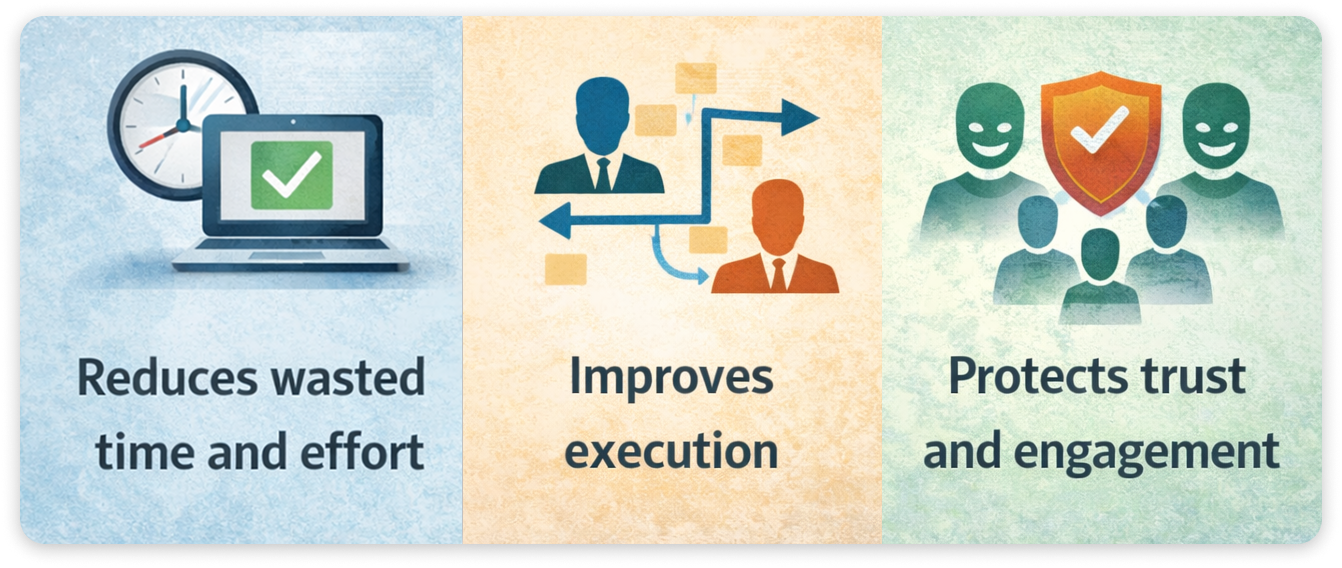
When information is easy to find, clearly targeted, and consistently reinforced, people stop hunting through emails and chat threads for basic answers and can focus on doing their actual work.
Meetings become shorter because fewer things need to be clarified, decisions happen faster because everyone is working from the same information, and projects move forward instead of looping back on themselves.
For the company, this means fewer paid hours lost to searching, correcting mistakes, or redoing work that could have been done right the first time, so the same payroll starts producing more real output without adding headcount or pressure.
Strategy only works if it survives the trip from leadership to teams, and a clear internal communication strategy makes sure priorities are explained consistently at every level of the organization.
When that happens, teams stop guessing what matters this quarter or which version of the plan is current, and effort starts to concentrate on the same goals instead of spreading thin across half-aligned initiatives.
This will protect one of your most expensive resources, which is focus, because budgets, time, and people are no longer diluted across competing interpretations of the strategy and can instead compound toward the outcomes the company actually wants.
When employees feel informed, are not surprised by changes, and are not forced to piece things together from rumors or outdated messages, trust stays intact and engagement remains high.
It prevents frustration from building, limits the spread of cynicism, and helps keep even strong performers engaged instead of looking for a way out.
For the company, this has very real consequences, because replacing people is expensive, onboarding takes time, and productivity always drops during transitions, so clear and consistent communication ends up protecting retention, morale, and the institutional knowledge that keeps the business running smoothly.
In short, you do not need an internal communication strategy just to “send better messages,” but to stop wasting time on avoidable friction, money on rework and misalignment, focus on confused priorities, and talent on preventable disengagement and turnover.
A good internal communication strategy turns communication into an operational system that protects your resources, improves execution, and makes sure the company actually gets results from the decisions it makes.
Here’s how to build an internal communication strategy that actually works.
You need to figure out where you are right now. Start with an honest audit of your company’s current state:

Map your audience:
✅ How many employees do you have?
✅ Where are they located? (Office, remote, frontline, hybrid?)
✅ What’s their tech access? (Desk workers vs. warehouse workers vs. field teams)
✅ What departments and roles exist?
Assess your current performance:
✅ Which communication channels are you using?
✅ Which ones actually get engagement?
✅ Where are the gaps? (Are frontline workers getting updates late? Are remote teams feeling disconnected?)
Talk to your people:
✅ Run surveys asking employees what information they need most and where they currently go to get it
✅ Conduct focus groups or listening tours
✅ Interview middle managers about their biggest communication pain points
This step is important because every communication problem you’re trying to fix is rooted in reality, not theory.
If you don’t understand how information actually moves through your company today, you’ll end up designing a strategy that is not suitable for your company’s current situation.
Now that you know where you are, you need to decide where you want to go?
Your internal communication goals should support your business goals. Don’t set them in isolation. Connect them to what your company is actually trying to achieve.
To make sure your internal communication goals actually drive results, use the SMARTER framework.
| Letter | Principle | Description |
| S | Specific | Your goals need to be specific. For instance, increase employee understanding of Q1 strategic priorities by 40%”. |
| M | Measurable | Define clear metrics (survey scores, engagement rates, time-to-find-information) |
| A | Achievable | Don’t set goals you can’t reasonably hit with your resources |
| R | Relevant | Align with business KPIs (productivity, retention, safety, revenue) |
| T | Time-bound | Set deadlines (quarterly, annually) |
| E | Evaluate | Build in check-ins to assess progress |
| R | Readjust | Be ready to pivot if something isn’t working |
This is where you start putting the strategy into practice. You choose your channels, plan your content, and decide how your messages will be delivered.
And don’t depend on only one channel, because different employees need to receive information in different ways.
For instance:
| Channel | Best For | When to Use It |
| Employee App | Frontline/mobile workers | Push notifications, two-way feedback, quick updates |
| Intranet | Desk-based staff | Central hub for searchable resources, policies, deep-dive content |
| Digital Signage | Common areas, factories | High-visibility reinforcement of key messages |
| Scheduled updates | Weekly digests, formal announcements | |
| Direct Manager | Individual/team level | Cascading change, nuanced discussions, personalized context |
| Desktop Alerts | Urgent/critical info | IT outages, emergency notifications |
You can also create a content calendar. It helps you plan what you’ll communicate and when, so important updates don’t get forgotten, rushed, or piled on at the last minute.
For instance:
You also need to be deliberate about who receives what. Not every message is meant for everyone, and sending everything to everyone is one of the fastest ways to create noise.
By segmenting your audience by role, location, or level of access to technology, you can keep messages relevant and avoid clogging inboxes with information that does not apply to them.
Finally, plan for things not going according to plan. Channels go down, schedules get disrupted, and unexpected situations happen.
Having backup options and clear alternatives means your communication does not stop when something breaks or a crisis hits.
You need to measure your communication efforts to know what’s working and what isn’t. Without measurement, you’re just guessing.
Start with hard metrics that show how people actually interact with your messages. This includes:
These numbers help you see, in concrete terms, whether your messages are reaching people and whether your channels are doing their job.
But numbers alone don’t tell the full story, so you also need to track softer signals:
Together, these show whether your communication is not only being seen, but also being understood and believed.
Once you have this data, use it to experiment and improve. You can:
Over time, these small tests show you what actually resonates with your employees, so you can focus more on what works and stop wasting effort on what doesn’t.
Finally, make sure communication is not a one-way street.
Don’t just send messages and hope for the best. Create simple ways for employees to respond, ask questions, and share concerns through pulse surveys, feedback tools, or open forums.
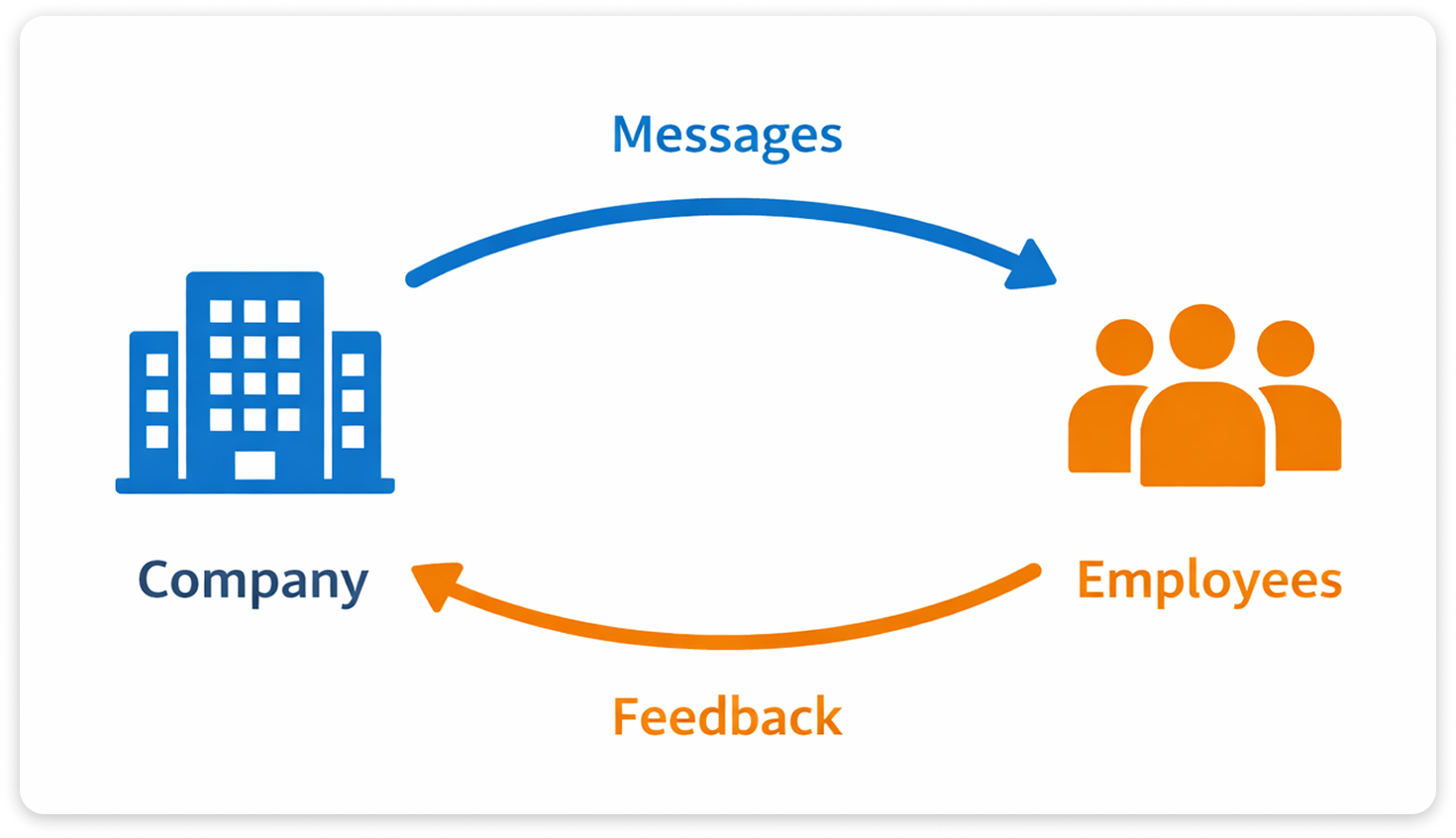
This closes the loop and gives you ongoing insight into what people need, what’s confusing, and where your communication can improve.
Here’s what it really costs when you don’t have a proper internal communication strategy:
When communication is inconsistent, contradictory, or nonexistent, people stop listening.
They assume leadership doesn’t know what they’re doing—or worse, doesn’t care. Engagement scores tank, and your best people start quietly updating their LinkedIn profiles.

You announce a big transformation. Leadership is exciting. And then… crickets.
Because middle managers don’t know how to explain it, frontline workers never heard about it, and remote teams are wondering what happened.
Without a strategy to cascade change effectively, your initiatives die before they even start.
When employees spend weeks every year just searching for information, that time is not free.
You are still paying their salaries while they look for documents, wait for replies, or try to figure out what the latest version of something is.
On top of that, when people get frustrated and leave because of poor communication, replacing them is expensive.
Hiring, onboarding, and training a new employee often costs more than the person’s annual salary. So poor communication doesn’t just waste time, it also quietly drives up your hiring costs.
In industries like manufacturing, healthcare, or logistics, poor communication doesn’t just hurt productivity—it can literally injure or kill people.
When critical safety updates don’t reach workers in time, or when compliance policies aren’t clearly understood, your brand faces serious legal and reputational risk.
While your teams are slowed down by unclear priorities and mixed messages, competitors with strong internal communication move faster, execute better, and make it easier for good people to want to work with them.
Companies that communicate well are much more likely to outperform others, and over time that advantage keeps growing, making it harder and harder to catch up.
Company culture doesn’t survive in a communication vacuum. When employees don’t know what’s happening, don’t trust leadership, and feel disconnected from the mission, your culture becomes toxic by default.
People start operating in silos, hoarding information, and protecting their turf instead of collaborating.
Here’s the bottom line: your internal communication strategy isn’t “nice to have.” It’s not an HR afterthought or something you delegate to an intern with a Canva account.
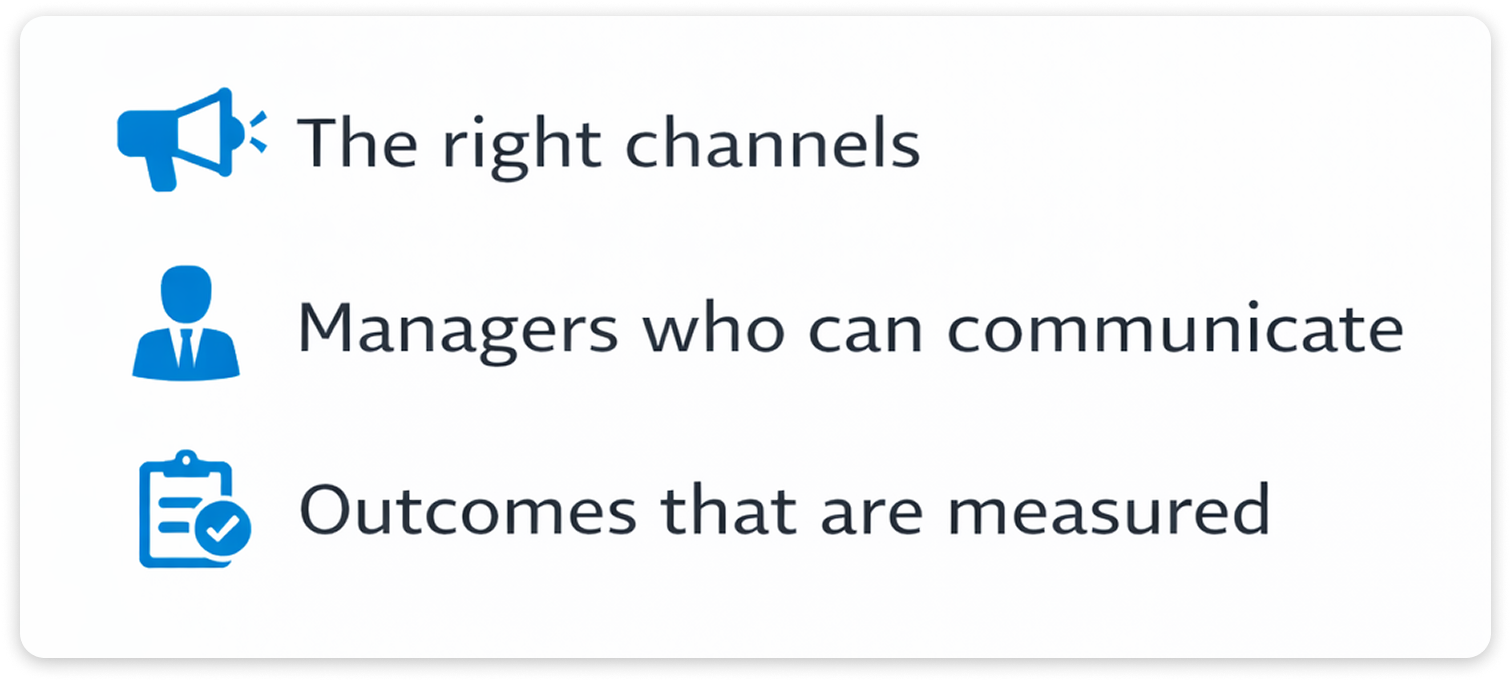
It’s a core business driver that directly impacts productivity, retention, trust, and your ability to execute on strategy. Companies that treat it that way—companies that invest in understanding their audiences, choosing the right channels, empowering managers, and measuring outcomes—are the ones winning in their industries.
So stop sending emails into the void. Stop assuming everyone saw the announcement. Stop wondering why your initiatives aren’t landing.
Build a real strategy. Audit where you are. Define where you want to go. Plan how you’ll get there. Measure whether it’s working. Adjust when it’s not.
Your employees deserve better than the communication chaos they’re currently navigating. Your business deserves better than the lost productivity and eroded trust that comes with it.
And if you want to take this further, start looking at corporate communication too. Internal communication is part of the bigger picture. When both are aligned, messages land better, trust builds faster, and execution gets easier.
A: Most organizations start seeing early improvements (fewer repeated questions, better message reach, higher engagement) within 60–90 days.
Bigger shifts like improved execution, trust, and alignment usually take one to two quarters, because they depend on behavior change, not just better tools or messages.
A: Ideally, ownership sits with a small cross-functional group: leadership (for direction), HR or Internal Comms (for consistency), and Operations or IT (for execution).
One person should be accountable, but success depends on managers actually using the system, not just a central team publishing messages.
A: Yes, but it doesn’t need to be complex. In small teams, communication breaks even faster because everything is informal and undocumented. A lightweight strategy helps prevent misalignment, duplicated work, and founder bottlenecks as the company grows.
A: The biggest lever is message prioritization and targeting. Not every update goes to everyone, and not every channel is for every message. Clear rules about what goes where and who gets what reduce overload far more than sending fewer messages.
A: There’s no universal stack, but most organizations need:


 PR playbook to get your brand cited in AI answer
How to check and fix what AI says about your brand
2 minutes checklist to make your PR AI-friendly
PR playbook to get your brand cited in AI answer
How to check and fix what AI says about your brand
2 minutes checklist to make your PR AI-friendly