New Media Unlocked!
You can now publish on USA TODAY through MarketersMEDIA. That's 142M+ monthly visitors and DR 92 backlinks for every release you publish.
Better reach, better SEO, better credibility.

You can now publish on USA TODAY through MarketersMEDIA. That's 142M+ monthly visitors and DR 92 backlinks for every release you publish.
Better reach, better SEO, better credibility.
Table of Content


The distinction between advertorial vs editorial content drives one of the most consequential decisions in public relations and content marketing.
One format earns its place in a publication through news value and journalistic judgment.
The other secures placement through payment. Both serve legitimate purposes.
The mistake most brands make is not choosing one over the other but failing to understand what each format actually delivers.
Editorial content is produced by a publication’s own writers, editors, or journalists. It runs because the publication decided the story had merit for its audience.
That independence is exactly what gives editorial coverage its weight.
When a journalist covers your product launch, reports on your research, or includes your company in an industry analysis, they are lending the publication’s credibility to your brand.
For example, this article includes a journalist byline, showing it was produced by Business Insider’s editorial team and published as independent newsroom reporting:

Readers understand that editorial content goes through a vetting process that no payment can replicate. The story ran because someone external to your organization found it worth telling.
This is a different kind of trust from anything advertising can produce.
Editorial content is also defined by its underlying intent. It aims to inform, analyze, or educate.
A well-placed editorial feature can generate more lasting brand authority than a series of paid placements, precisely because it does not read like a sales effort.
An advertorial is paid content designed to look and read like editorial material. The term blends “advertisement” and “editorial,” and that combination is deliberate.
Advertorials borrow the format, structure, and tone of a genuine article while serving a promotional purpose.
A well-executed advertorial reads like a feature piece. A poorly executed one reads like a product brochure someone dressed up in a headline.
Most advertising standards and disclosure regulations in major markets require a clear label on advertorial content.
In the United States, the Federal Trade Commission requires disclosure when content is paid for or sponsored.
The same requirements apply under the UK’s ASA guidelines and equivalent bodies across most markets. The label exists because readers deserve to know they are being sold to.
For example:
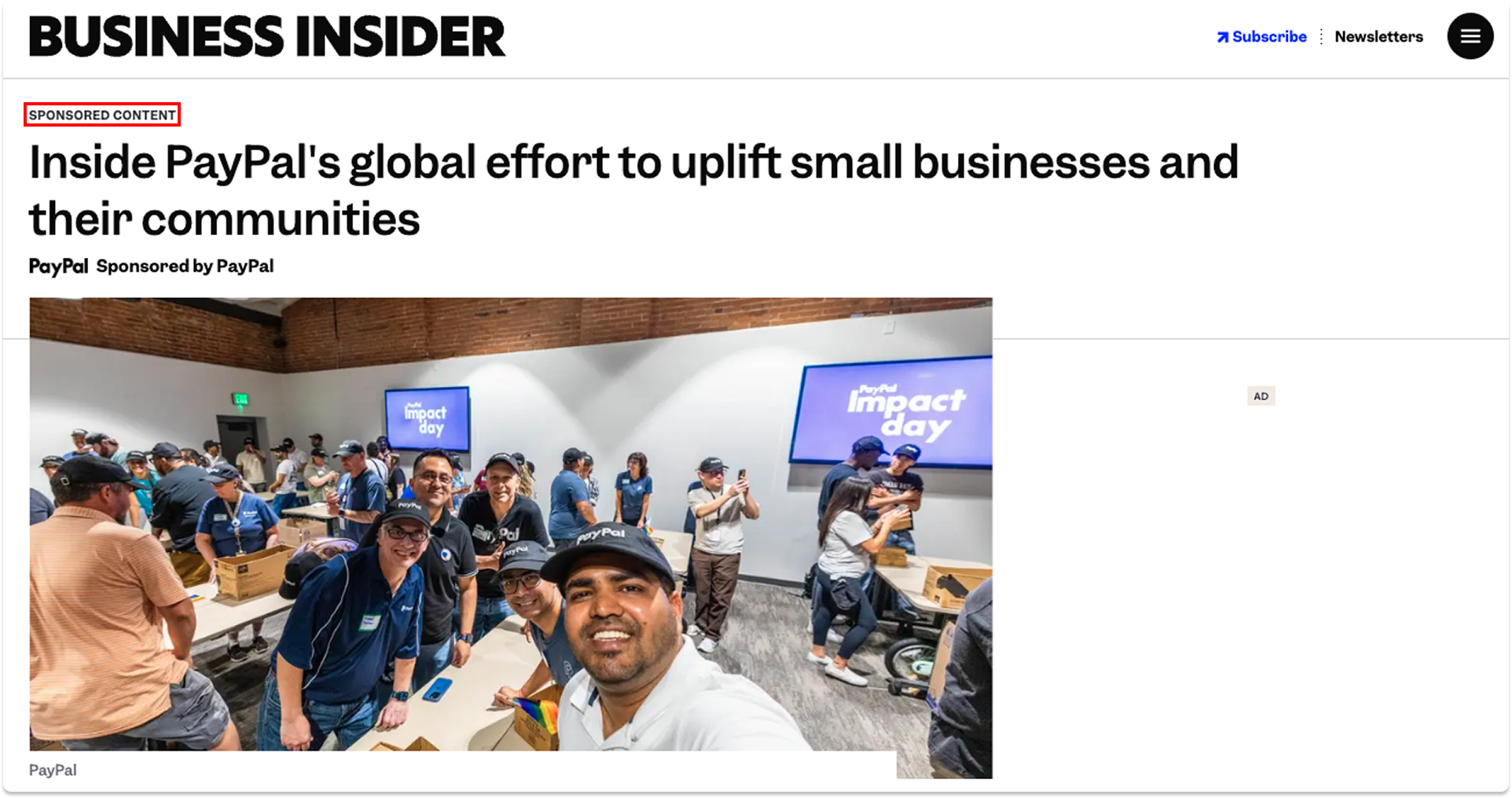
Advertorials work when the brand has something genuinely valuable to communicate, when the content serves the reader, and when the promotional intent does not overwhelm the information.
They fail when the “article” is a sales pitch wearing editorial clothing.
The use cases that tend to justify advertorials include product launches where detailed education benefits the reader, complex services that gain from narrative explanation, and campaign scenarios where guaranteed placement on a specific timeline is a hard requirement.

Use press releases to get your brand mentioned and recommended by ChatGPT, Gemini, and Perplexity when people search.
 PR playbook to get your brand cited in AI answersHow to check and fix what AI says about your brand2 minutes checklist to make your PR AI-friendly
Where would you like to receive the AI PR toolkit:
Here is how the two formats compare across the dimensions that matter most:
| Dimension | Editorial | Advertorial |
| Who creates it | Publication’s journalists or editors | Brand or its agency |
| Who controls the message | The publication | The brand |
| Payment | No payment for coverage | Brand pays for placement |
| Credibility signal | High, coverage is earned | Moderate to low depending on execution |
| Disclosure requirement | None | Required (sponsored/paid label) |
| Placement guarantee | None | Yes |
| Primary goal | Inform, analyze, educate | Promote, convert, build awareness |
| Reader trust | High | Depends heavily on execution |
Both formats have a place in a well-structured PR program. Understanding which belongs at any given moment is what separates effective PR planning from guesswork.
The paid vs. earned distinction made intuitive sense in print media. An ad was an ad. An article was an article.
The physical separation between sponsored pages and the editorial section was built into the magazine itself.
Online, that separation has become harder to maintain. Brands now publish content on their own platforms.
A company blog post is not editorial in the traditional sense, but it is not paid advertorial either. It sits in a category called owned media, which has no direct equivalent in print.
When that blog post gets syndicated, cited, or picked up by another outlet, it can carry editorial weight without ever having passed through a journalist’s vetting process.
The rise of native advertising, sponsored content networks, and branded journalism has created a spectrum rather than a binary.
Some content is clearly editorial. Some are clearly paid advertorial.
A significant portion sits between the two, blending formats, intentions, and distribution models in ways the industry is still working through.
Understanding where your content sits on that spectrum shapes how audiences and search engines respond to it.
Press releases occupy a position in this landscape that most discussions of advertorial vs editorial overlook entirely.
A press release is not an advertorial.
You are not paying a publication to carry your story as though it were their own journalism. The release goes out through a distribution network to newsrooms, editors, journalists, and media databases.
Whether a journalist then covers your story is an editorial decision that you do not control.
At the same time, a press release is not traditional editorial content. Your team wrote it, your organization controls the narrative, and the purpose is to advance your brand’s story.
What a press release does, when distributed through a capable network, is create the conditions for editorial coverage while also generating its own layer of documented media presence.
When a release is published on established news sites and media platforms, it carries the credibility of appearing within those outlets.
The URLs are indexed. The brand appears in a media context rather than an advertising context.
That is meaningfully different from a sponsored placement. It positions your announcement as a legitimate news item rather than a paid insertion, and it does so at scale.
Platforms like MarketersMEDIA Newswire distribute press releases to a network covering over 2,000 media endpoints, including outlets such as Business Insider, AP News, Yahoo News, and Barchart.
The coverage generated is not advertorial.
It is distributed content that creates indexed, credible visibility across channels your audience already trusts.
For brands thinking through their approach to advertorial vs editorial content, press release distribution represents a third category worth understanding: a format that preserves your narrative control while generating the credibility signals that paid placements alone cannot produce.
Want your brand story featured on credible media outlets?
MarketersMEDIA Newswire helps you get the kind of third-party visibility these big brands achieved—through press release distribution to established publications. Get in touch with us today.
The format you reach for should follow directly from what you are trying to accomplish.
Editorial coverage works because it is not yours.
When a journalist, editor, or publication covers your brand without being paid to do so, they are lending their audience’s trust to your story.
Readers know the difference between a story that ran because a publication decided it was worth telling and a placement that exists because a brand paid for it.
That distinction matters enormously for how your brand is perceived over time.
Third-party validation compounds. Each earned mention builds a public record of credibility that paid placements cannot replicate, regardless of how well-executed those placements are.
Editorial coverage does not happen passively. It requires active relationship building with journalists, editors, and producers who cover your space.
That means understanding what they write about, what angles they find interesting, and what story formats their publications favor.
A pitch that lands needs to show a journalist why their audience specifically would care about your story at this moment.
This takes time, research, and a willingness to hear no. Brands that treat media outreach as a one-time submission exercise tend to see poor results. Brands that treat it as an ongoing relationship investment see compounding returns.
Not every company development qualifies as editorial news.
A product launch is notable to your customers. A funding round matters to your investors. A rebrand is significant internally.
But for a journalist to write about any of those, there needs to be a reason their readers, who are not already your audience, would find the story valuable.
Editorial coverage is most accessible when your news connects to a trend, a shift in the industry, a research finding, or a human story that gives external readers a reason to care.
If you can articulate why a journalist’s audience would benefit from knowing your story, you have a pitch worth making.
This is the single biggest operational reality of editorial coverage, and it catches brands off guard most often.
A journalist may love your pitch and still not run the story for weeks, or at all, because something more timely took priority.
An editor may want to include your company in a roundup but push the piece to the following quarter.
You have no contractual claim on when or whether the story runs.
For brands with flexible timelines and long-term credibility as the primary goal, this uncertainty is manageable.
For brands running a coordinated launch campaign with a fixed go-live date, editorial is a complement to your plan, not the mechanism that drives it.
Campaigns with hard deadlines, product launches with coordinated multi-channel rollouts, and event-driven announcements all require content that will appear when you need it.
Advertorial solves this problem cleanly.
Because you are paying for the placement, the publication commits to running your content on the schedule you agree to.
This predictability makes advertorial the practical choice whenever your PR activity needs to align precisely with other campaign elements such as a paid ad push, an email sequence, a social campaign, or a live event.
The guarantee is the point.
Editorial coverage tends to favor news angles, narrative, and independent relevance. It is not the right vehicle for walking readers through a product’s specific features, how it works, who it is for, and why it solves a particular problem better than the alternatives.
Advertorial gives you the space and the control to do exactly that.
A well-written advertorial can take a reader from awareness to genuine understanding of your product’s value in a way that a news mention or a brief feature reference cannot.
This is particularly relevant for products in complex categories, regulated industries, or technical markets where educated prospects convert at meaningfully higher rates than uninformed ones.
For example:

This TechCrunch article reports on Amazon’s healthcare AI assistant launch as a news event. The story focuses on the announcement and its implications rather than providing a detailed walkthrough of the product’s features or use cases.
Some campaigns require multiple pieces of content to land in specific publications at the same time.
A category-level brand push, a market entry announcement, or a product launch in a new geography may call for simultaneous coverage across five or ten different outlets.
Achieving that through editorial outreach alone is close to impossible.
Publications make independent decisions on independent timelines. Advertorial is the mechanism that allows you to coordinate placements across multiple outlets with the precision a real campaign requires.
You know what will run, where it will run, and when.
This is worth being direct about. Most brand announcements, however significant internally, do not have the independent public interest that editorial coverage requires.
A new product feature, a service expansion, a company milestone, a leadership hire — these are real and meaningful to your organization.
But unless they connect to a wider story that a publication’s audience would find independently valuable, a journalist has no editorial justification to cover them.
Advertorial allows you to tell those stories anyway, in a format that places them in front of a relevant audience, without requiring that the story clear an editorial interest test it was never designed to pass.
Press release distribution is built for brand moments that are genuinely newsworthy within your industry, even if they do not rise to the level of mainstream editorial interest.
A product launch, a funding announcement, a new partnership, a leadership change, an award, a market expansion — these are all appropriate subjects for a press release.
The format is specifically designed to communicate structured news in a way that publications, journalists, and media databases are equipped to receive and index.
It is the right tool when you have a real story to tell and want it to reach media channels with credibility and structure.
Press release distribution through a newswire network delivers your announcement to hundreds or thousands of media endpoints in a single submission.
Reaching the same coverage through individual advertorial placements on each outlet would cost orders of magnitude more and take considerably longer to arrange.
Distribution platforms like MarketersMEDIA Newswire carry your release across over 2,000 media endpoints, including outlets such as Business Insider, AP News, Yahoo News, and Barchart, through one submission.
The economics of scale make distribution the practical default for brands that need broad reach without the per-outlet negotiation that a placement-by-placement advertorial strategy requires.
Agencies, in-house PR teams, and brands running structured campaigns often require evidence that their announcements were published and are accessible.
Press release distribution produces verifiable proof of publication in the form of live URLs and PDF reports across every outlet where the release appeared.
This documentation supports client reporting, internal performance tracking, and audit trails that demonstrate PR activity and reach in concrete terms.
It is also the format that produces the kind of structured, indexed record that search engines and AI systems can ingest, extending the value of the announcement well beyond the initial publication window.
A single press release does not transform a brand’s visibility. A consistent publishing program does.
Each release that goes out and gets indexed on established media domains adds to a growing public record of your brand’s activity, announcements, and positioning.
Over time, that record works in your favor across search results, AI-generated answers, and journalist research.
When a journalist searches your company before writing a story, or when an AI model references your brand in a response, what they find is partly shaped by the media presence you have built through consistent distribution.
Press release distribution is the mechanism for building that presence systematically, at a cadence and cost structure that makes ongoing publishing viable.
The difference between advertorial vs editorial content is not simply a question of credibility versus promotion. It is a question of fit.
Each format serves a different purpose within a modern PR strategy.
Editorial coverage delivers something no paid placement can replicate: independent validation.
When a journalist chooses to write about your company, the credibility of the publication becomes part of your story. That trust signal builds slowly, but it compounds over time.
Advertorial serves a different role.
It gives brands control over the message, the timing, and the level of detail. When a campaign requires guaranteed placement, product education, or coordinated messaging across multiple channels, advertorial becomes the practical tool.
Press release distribution sits between these two models.
It allows organizations to control their narrative while placing their announcements in credible media environments where they can be indexed, discovered, and potentially picked up by journalists.
The result is visibility that supports both credibility and reach.
The most effective PR strategies do not treat these formats as competitors. They treat them as complementary tools.
Editorial coverage builds trust. Advertorial communicates detailed value. Press releases create scalable visibility across the media ecosystem.
Understanding how and when to use each is what turns PR from a hopeful outreach exercise into a structured, repeatable system for brand visibility.
A: Native advertising and advertorials overlap, but they are not identical. Native advertising refers broadly to paid content that matches the form and function of the platform where it appears, including in-feed social posts, recommendation widgets, and sponsored listings. An advertorial is a specific format: long-form paid content styled to resemble a feature article or editorial piece. All advertorials can be considered native advertising in function, but not all native ads are advertorials.
A: Advertorials can contribute to SEO, but the value depends on how the placement is structured. Many publications apply “nofollow” or “sponsored” link attributes to paid placements, which limits the direct link equity passed to the brand’s website. Organic editorial coverage and press release distribution on indexed news domains tend to deliver stronger and more durable search visibility over time.
A: In the United States, the FTC requires clear disclosure when content is paid for or constitutes a compensated endorsement. The UK’s ASA applies similar standards under the CAP Code. The specific label format varies by platform and jurisdiction, but the principle is consistent across major markets: readers must be able to identify paid content before engaging with it. Failure to disclose can result in regulatory action against the brand, the publisher, or both.
A: Journalists and editorial teams are generally separate from the advertising and sales departments that handle advertorial placements. The same publication can carry advertorial content without editorial staff endorsing or participating in it. Brands building journalist relationships for earned coverage should keep PR outreach distinct from their paid placement activity. Blurring the two can undermine the credibility of legitimate news pitches.
A: No. A press release distributed through a newswire network is delivered to journalists, editors, and newsrooms, but whether they choose to cover the story is an independent editorial decision. Distribution guarantees the release reaches relevant media contacts and is published across the distribution network’s own channels. Whether additional journalists pick up the story depends on the news value of the release and the strength of the angle it presents.


 PR playbook to get your brand cited in AI answer
How to check and fix what AI says about your brand
2 minutes checklist to make your PR AI-friendly
PR playbook to get your brand cited in AI answer
How to check and fix what AI says about your brand
2 minutes checklist to make your PR AI-friendly