New Media Unlocked!
You can now publish on USA TODAY through MarketersMEDIA. That's 142M+ monthly visitors and DR 92 backlinks for every release you publish.
Better reach, better SEO, better credibility.

You can now publish on USA TODAY through MarketersMEDIA. That's 142M+ monthly visitors and DR 92 backlinks for every release you publish.
Better reach, better SEO, better credibility.
Table of Content


Most marketers use social listening and social monitoring as if they mean the same thing.
They don’t.
One focuses on responding to conversations. The other focuses on understanding them. Treating them as interchangeable means your brand is either constantly reacting without a strategy, or building strategy without knowing what’s actually happening on the ground right now.
The confusion is understandable.
Both involve tracking what people say online. Both use similar tools. Both require attention to social media platforms.
But the intent, the scale, and the outcomes are completely different — and confusing the two is one of the more common reasons brands feel like their social media efforts aren’t paying off.
Understanding the difference helps your brand improve customer support, sharpen your marketing strategy, and make smarter product decisions.
Social monitoring tracks mentions of your brand and helps your team respond to customers in real time.
Social listening analyzes broader conversations to uncover trends, sentiment shifts, and opportunities your brand can act on strategically.
| Social Monitoring | Social Listening | |
| What it does | Tracks brand mentions | Analyzes conversations |
| Primary focus | Customer support | Strategic insights |
| Approach | Reactive | Proactive |
| Time horizon | Short-term actions | Long-term strategy |
| Scale | Individual mentions | Industry-wide patterns |
| Core question | What are people saying about us? | Why are people saying it? |
Think of monitoring as your brand’s eyes — scanning for what’s happening right now, catching issues before they spread.
While listening is your brand’s ears — picking up signals across the entire industry to understand where things are heading before you can see it yet.
Neither one replaces the other. They solve different problems.
Social media monitoring is the process of tracking brand mentions, comments, and tags across social platforms so your team can respond to customers quickly.
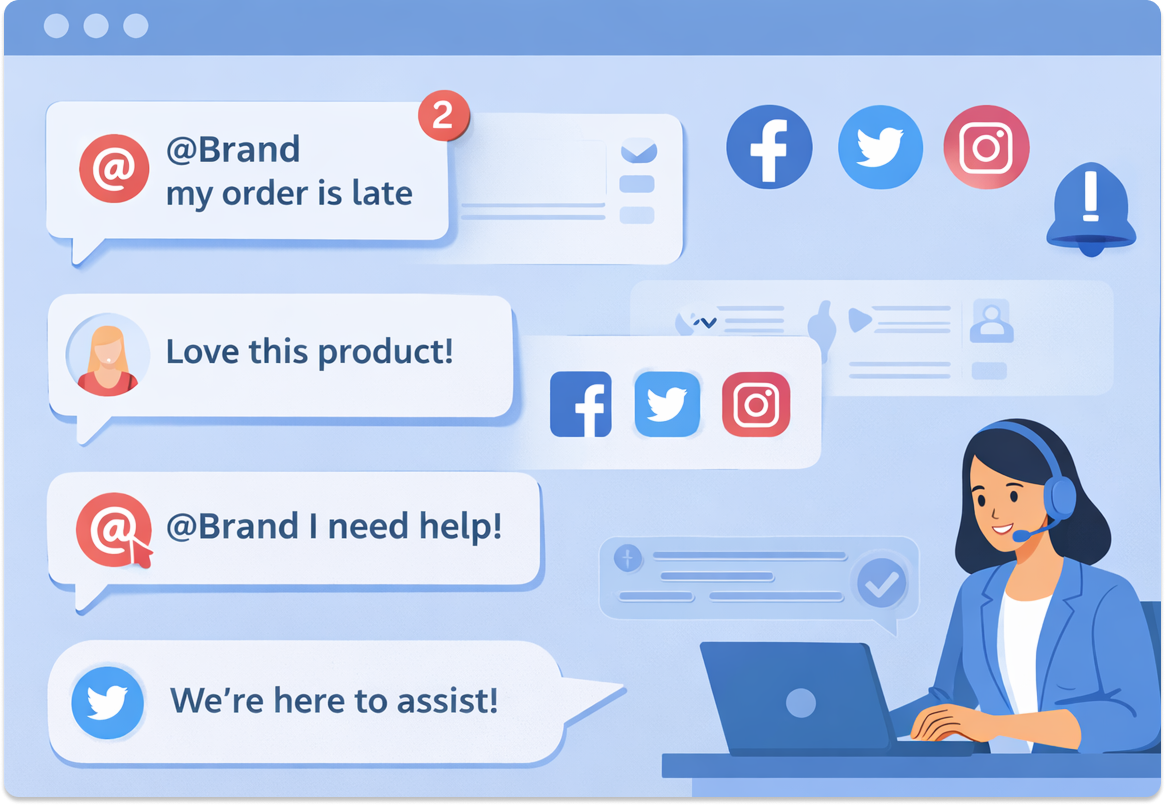
It’s ground-level work. You’re watching what people say directly to or about your brand — and responding in a timely, deliberate way.
There’s no broad analysis happening here. The goal is awareness and speed.
At its core, monitoring works by setting up keyword and mention alerts tied to your brand name, product names, key executives, branded hashtags, and common misspellings of all of the above.
When any of those terms appear across social platforms, your monitoring tool surfaces them for your team to review and respond to.
The response itself is the output.
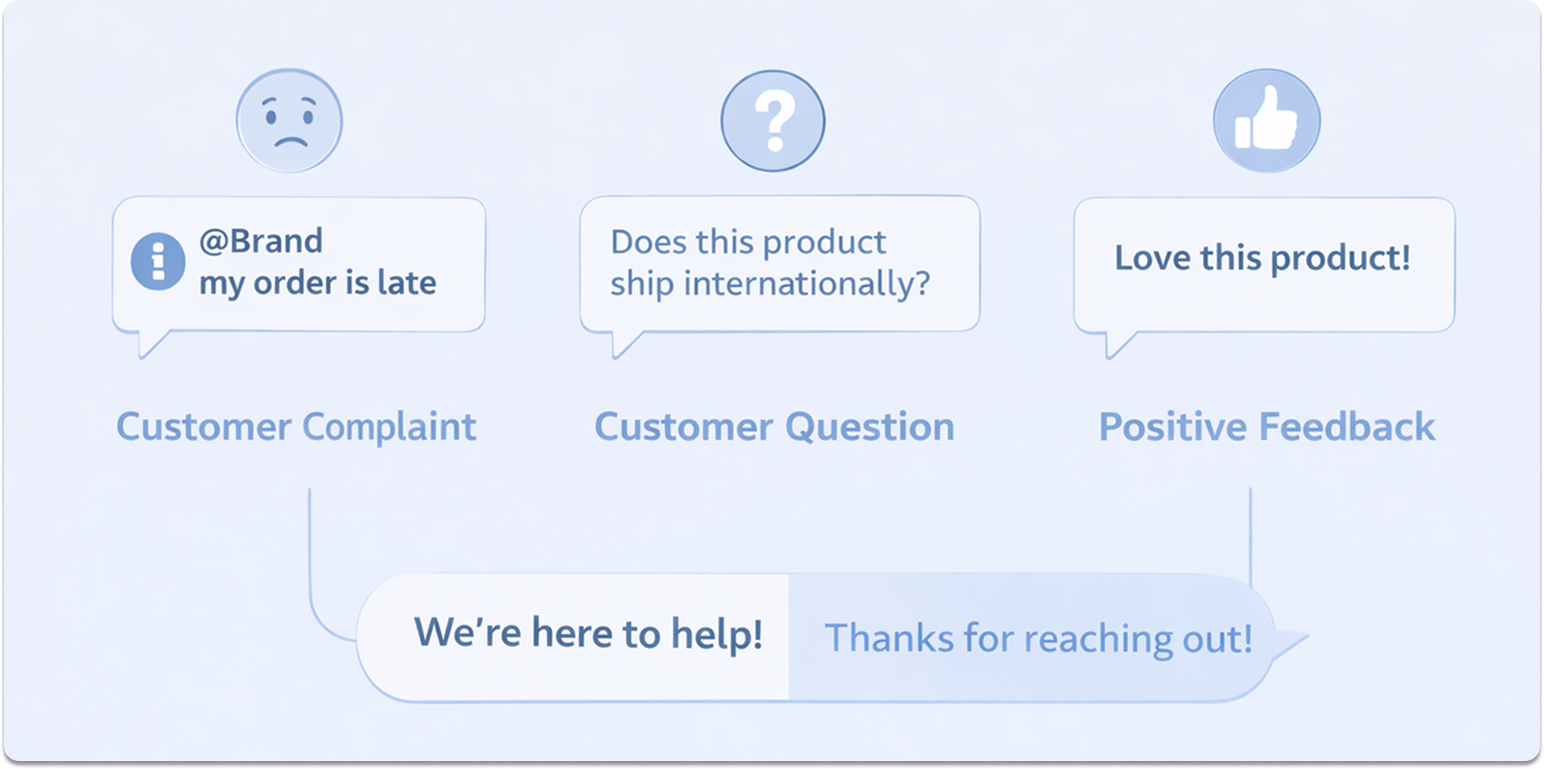
What makes monitoring valuable is the consistency and speed at which those interactions happen. A brand that responds within an hour signals something very different from a brand that responds three days later — or not at all.
This brand uses monitoring aggressively during product launches.
When a new sneaker drops and fans post unboxing content or tag the brand, Nike’s team engages quickly, liking, replying, and amplifying fan content in real time.
For example:
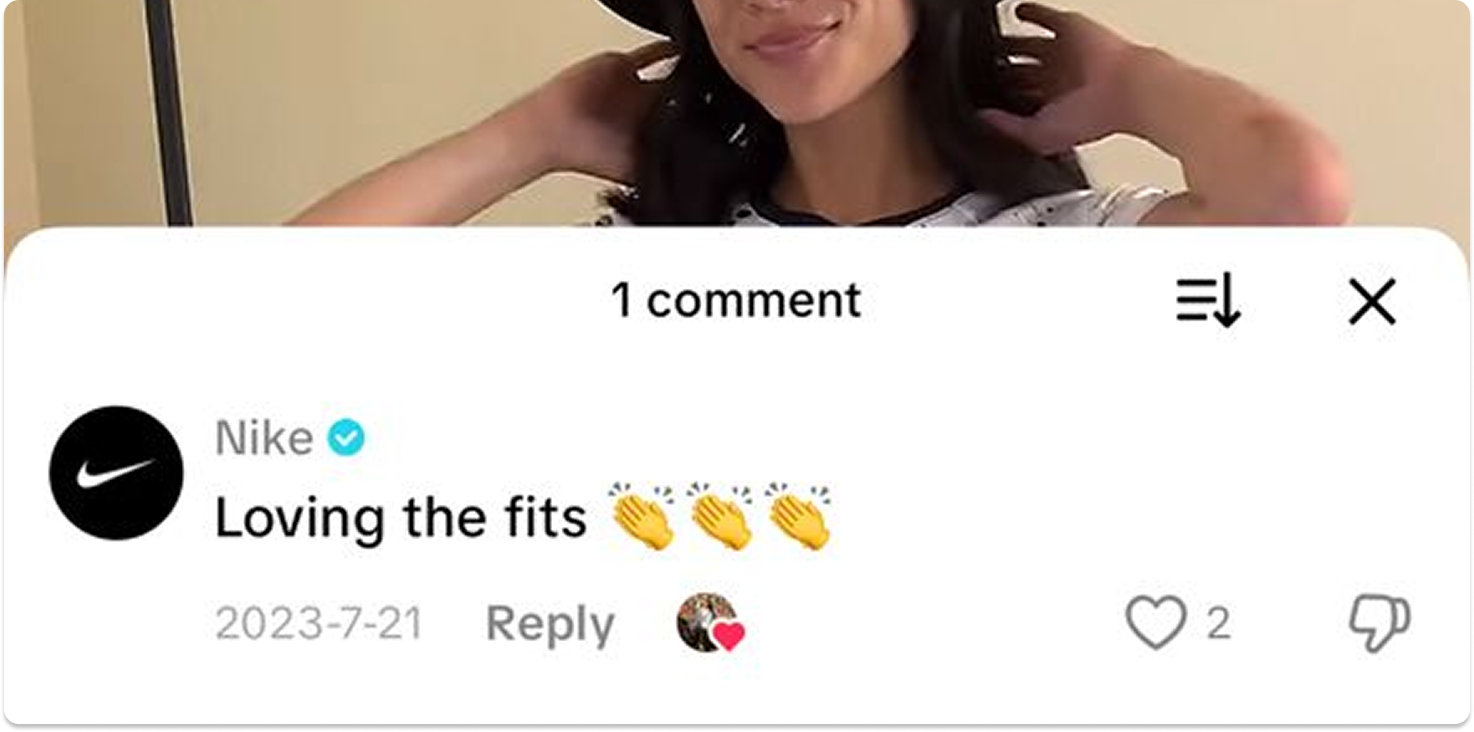
This turns individual customers into visible advocates at exactly the moment their enthusiasm is highest.
Zappos became famous for its social customer service long before most brands took it seriously. Customers who tweeted about shoe problems, shipping delays, or return questions received replies that were fast, personal, and often went further than the customer expected.
The brand built genuine loyalty through monitoring alone — not through big campaigns, but through consistent, attentive responsiveness.
Customers don’t call support lines the way they used to. They post publicly. A brand that isn’t monitoring is a brand leaving complaints unanswered in front of everyone — and potential customers who see those unanswered posts draw their own conclusions.
According to Sprout Social, 69% of consumers expect a response from brands on social media, and nearly half expect that response within a few hours.
Missing that window doesn’t just disappoint one customer — it signals to every observer that your brand doesn’t pay attention.
A negative post that receives a fast, empathetic response rarely spreads. One that sits unanswered for hours can compound.
The speed of your monitoring directly determines whether a complaint stays contained or grows into something that needs a formal PR response.
Fast replies also demonstrate accountability publicly.
When your brand acknowledges an issue and moves to resolve it, you’re not just helping the individual customer.
You’re showing every observer that problems get handled here, which is a core part of effective reputation management.
When your brand notices a customer who shares a positive experience — replies, thanks them, reposts what they said — it turns a transaction into a relationship.
That person feels seen.
They’re more likely to share again, more likely to stay loyal, and more likely to recommend your brand to others. Monitoring is what makes that possible, because you can’t respond to what you haven’t seen.
During a product launch or live event, monitoring lets your team see how audiences are responding in the moment.
If a campaign angle isn’t landing, or a specific message is generating unexpected pushback, you can adjust mid-campaign rather than waiting for a post-mortem two weeks later when it’s too late to change anything.
Social listening is the analysis of conversations across social platforms and the wider web to uncover insights about customer opinions, industry trends, and emerging opportunities.
Listening tools aggregate public conversations from across social platforms, forums, review sites, news publications, and community spaces like Reddit.
Instead of flagging individual mentions for response, they analyze the data at scale by tracking sentiment scores, conversation volume over time, keyword frequency, and topic clustering.
The output will be a picture of what your market thinks, feels, and wants. This data will be drawn from millions of organic, unprompted conversations.
That’s what makes listening fundamentally different from monitoring.
Monitoring captures what people say to your brand. Listening captures what people say about your industry, your category, and your competitors when no one is asking.
Netflix uses social listening to inform content decisions.
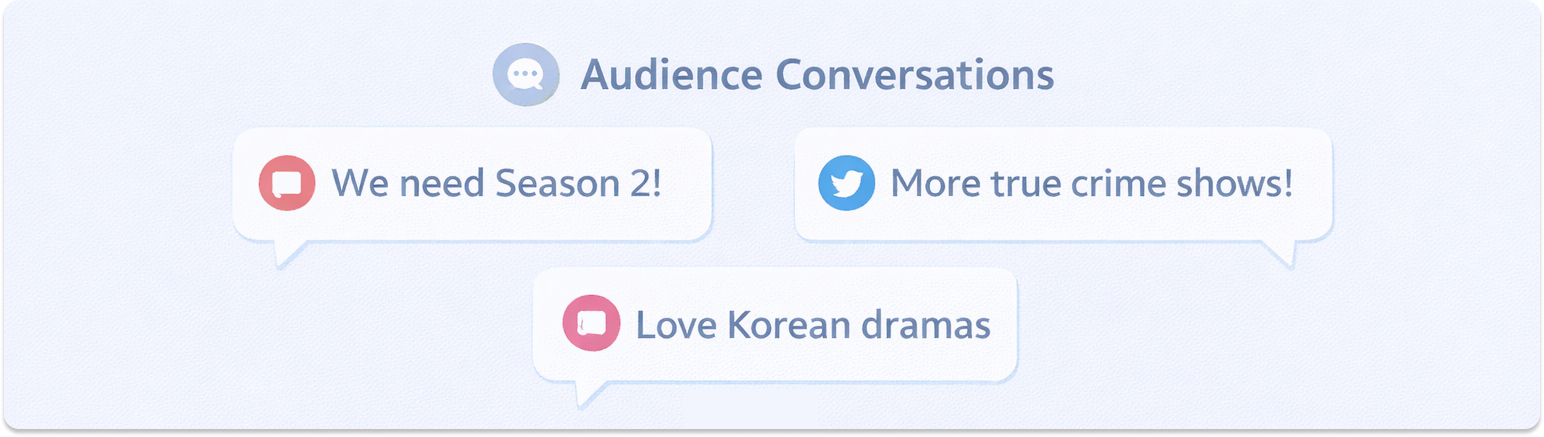
The platform monitors conversations about what audiences want to see more of — which genres are underrepresented, which storylines fans are discussing, which talent has organic buzz.
This isn’t just fan service; it’s a data-informed approach to content investment that reduces the guesswork involved in greenlighting new projects.
This brand built its entire content marketing strategy around listening.
The brand tracked how customers organically described their use cases — adventure sports, travel, family moments — and mirrored that language back in its own campaigns.
The result was marketing that felt native to the audience because it was drawn directly from how the audience already talked about the product.
Sentiment analysis through listening tells you whether the general mood around your product is shifting positively or negatively even when customers aren’t directly engaging with your brand accounts.
Perception problems often surface in listening data long before they appear in sales numbers or churn rates.
By the time you see the revenue impact, you’ve already missed the window to address it early.
By the time a trend hits an industry report, brands using social listening have already acted on it. The brands that got ahead of the sustainability conversation, the mental health conversation, and the short-form video conversation were not lucky.
They were listening early and moving while others were still waiting for confirmation in a quarterly report.
Repeated complaints, recurring questions, and common frustrations in online communities are essentially a free product development brief.
Social listening surfaces those insights faster and more authentically than any traditional survey could, because the feedback is unprompted, organic, and unfiltered.
People say things in Reddit threads that they’d never write in a structured survey.
When customers complain about a competitor’s slow support, confusing onboarding, or missing features, that’s your signal.
Social listening lets your brand track competitor sentiment and identify gaps in the market you can position against.
People who consistently recommend your brand in communities for free are among your most valuable marketing assets.
Social listening helps you find them before your competitors do, and before those creators have committed their attention elsewhere.
These are the people worth investing in because they were already invested in you.
Social monitoring solves immediate problems. Social listening solves strategic ones. Neither one covers the full picture alone, and treating them as separate functions misses the real value of running both in parallel.
Here’s how the feedback loop works when both are active:
The first signal typically appears through day-to-day social monitoring. Your team starts noticing a growing number of customer questions about how your product integrates with a particular third-party tool.
At first, each message looks like a normal support interaction.
Someone asks a question on X or LinkedIn. Another customer leaves a comment on Instagram. A few more send direct messages asking the same thing.
Your team responds to each one individually, providing helpful answers or clarifying whether the feature exists.
But over time, something becomes clear: the same question keeps appearing. The volume is high enough that the monitoring team flags it internally.
At this stage, monitoring has done its job. It has surfaced the individual signals coming directly from customers.
Once the signal is identified, social listening tools and analysis come into play. Instead of focusing only on your brand mentions, the listening process scans conversations across the wider internet.
This includes places such as:
The analysis reveals that customers are discussing the same integration across multiple platforms.
Some are asking whether your product supports it. Others are comparing different tools in your category and noting that none of them solve the problem well.
At this point, the issue is no longer just a support request. It becomes a market insight. Listening has taken the original signal and provided context and scale, showing that the demand exists beyond your immediate customer base.
Once the pattern is validated, the insight moves beyond marketing or customer support and reaches other teams inside the company.
Several actions can follow:
a) The product team may add the integration to its development roadmap. If enough demand exists, it becomes a feature worth building.
b) The marketing or content team may publish a detailed FAQ page explaining the current integration options and how customers can work around the limitation.
c) A content series might also be planned to address the broader use case. This could include blog posts, tutorials, or webinars explaining how customers can connect the tools they rely on.
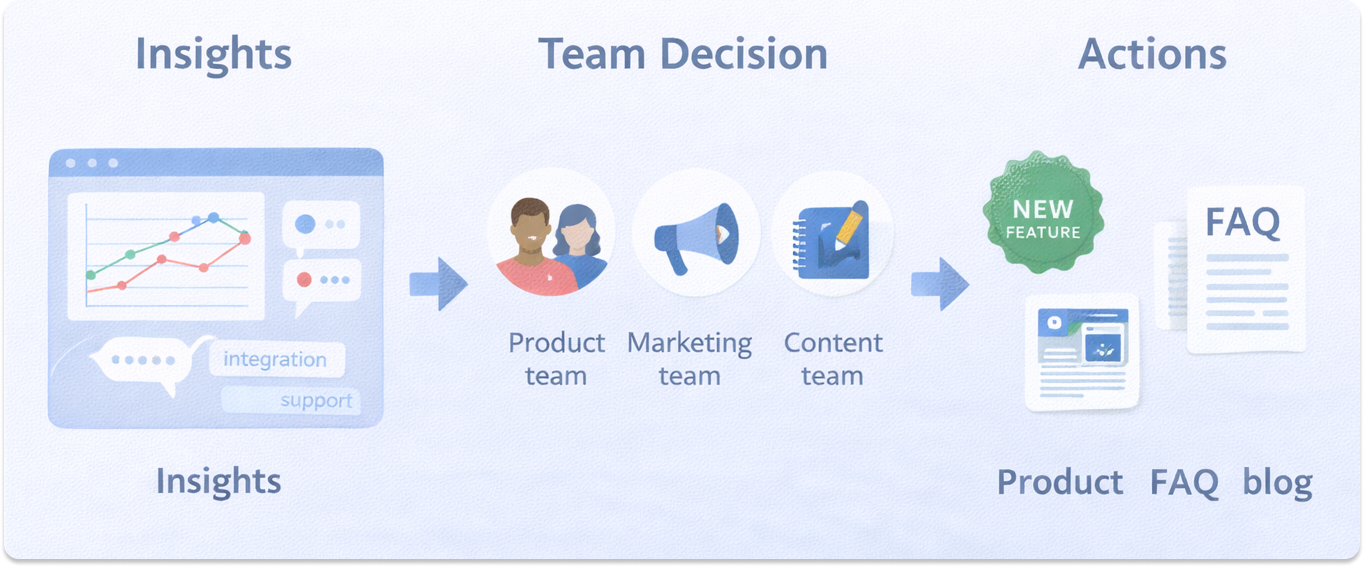
In this stage, the insight transforms into concrete decisions that improve the product, the documentation, and the overall customer experience.
Once the product update or content resources are released, the impact becomes visible.
Customers searching online for answers discover helpful content that addresses their needs before they even contact support.
Existing customers no longer need to ask the same question repeatedly. As a result, support ticket volume decreases.
More importantly, the brand begins to appear proactive. Instead of responding after problems arise, it looks like the company anticipated what customers needed and built resources to help them succeed.
That perception builds trust and strengthens long-term customer relationships.
In short, this is the cycle that emerges when monitoring and listening work together. Monitoring captures the individual signals.
Listening reveals the broader pattern behind those signals. Strategy then turns those insights into meaningful improvements that benefit both the company and its customers.
Social monitoring helps your brand respond to customers. Social listening helps your brand understand them.
Brands that only monitor are constantly reacting. Brands that only listen accumulate insight without the operational discipline to act on it in real time.
But, companies that commit to both end up with stronger customer relationships, faster issue resolution, and sharper long-term decisions.
Monitoring keeps the present stable. Listening builds the future.
If you want your brand’s story to reach real media and generate the coverage that both monitoring dashboards and listening tools can track, MarketersMEDIA Newswire distributes to over 2,000 media endpoints including Business Insider, AP News, and Yahoo News.
Get your brand into the conversation where it counts. Get in touch with us today!
A: Small businesses benefit from social listening just as much as large ones. The scale of data is smaller, but the insights are equally valuable. Budget-friendly tools like Brand24 and Awario give small teams the ability to track industry sentiment and competitor mentions without an enterprise budget.
A: Daily monitoring is the baseline for most brands. During high-stakes periods like product launches, campaigns, or public announcements, near-real-time monitoring is worth the additional attention. Customer support teams often check monitoring dashboards multiple times per day to maintain response speed.
A: Start with wherever your customers are most active. For most brands, that includes X (formerly Twitter), Instagram, Facebook, LinkedIn, and Google reviews. Reddit and TikTok are increasingly important, particularly for brands targeting younger demographics or operating in fast-moving product categories.
A: They overlap but are not the same thing. Traditional market research uses structured surveys and controlled methodologies. Social listening draws from organic, unstructured conversations in real time. Listening tends to surface genuine, unprompted sentiment — which often reveals things a survey wouldn’t capture because respondents didn’t know to say them.
A: Brands that only monitor become reactive by default. They get good at responding to problems but never build a system to anticipate them. Without listening, you miss emerging trends, competitor movements, and product opportunities until they’re already obvious — at which point brands that were listening earlier have already moved.


 PR playbook to get your brand cited in AI answer
How to check and fix what AI says about your brand
2 minutes checklist to make your PR AI-friendly
PR playbook to get your brand cited in AI answer
How to check and fix what AI says about your brand
2 minutes checklist to make your PR AI-friendly