New Media Unlocked!
You can now publish on USA TODAY through MarketersMEDIA. That's 142M+ monthly visitors and DR 92 backlinks for every release you publish.
Better reach, better SEO, better credibility.

You can now publish on USA TODAY through MarketersMEDIA. That's 142M+ monthly visitors and DR 92 backlinks for every release you publish.
Better reach, better SEO, better credibility.
Table of Content


Point of view is one of those writing decisions that looks minor until it isn’t.
Choose the wrong one and your press release reads like a sales pitch. Choose the right one and your marketing copy feels like a direct conversation with the reader.
Second person and third person are the two perspectives most relevant for professional writers, marketers, and PR professionals.
Each serves a distinct purpose.
Each creates a different relationship between the writer and the reader. And each is clearly the wrong choice in certain contexts, a reality that many content writers learn the hard way.
Second person writing directly addresses the reader. The narrator speaks to “you,” meaning whoever is reading the text becomes the subject of the action or instruction.
The defining pronouns are: you, your, yours, yourself, yourselves.
Example: Your press release reaches thousands of journalists the moment it goes live.
The second person creates immediacy. The reader isn’t observing from a distance; they are part of what’s being described.
This makes the style especially effective when the goal is to help the reader imagine themselves taking an action or experiencing a benefit. It is commonly used in areas such as:
In fiction, the second person is rare and intentionally disorienting. Jay McInerney’s Bright Lights, Big City is the most-cited example.

The unconventional choice pulls readers into an uncomfortable intimacy with the narrator’s unstable world, which is precisely the point. Outside of literary experiments, the second person in fiction tends to feel forced.
Third person writing refers to people, organizations, and events as external subjects, not as the reader and not as the author. The narrator observes and reports.
The defining pronouns are: he, she, it, they, him, her, them, his, hers, its, their.
Example: SurgeGraph’s latest update reduced content production time by 40% for enterprise clients.
The third person POV creates distance and distance, in the right context, creates authority.
News articles, press releases, academic papers, and case studies all rely on third person because the format signals objectivity. The writer steps back. The subject matter takes center stage.
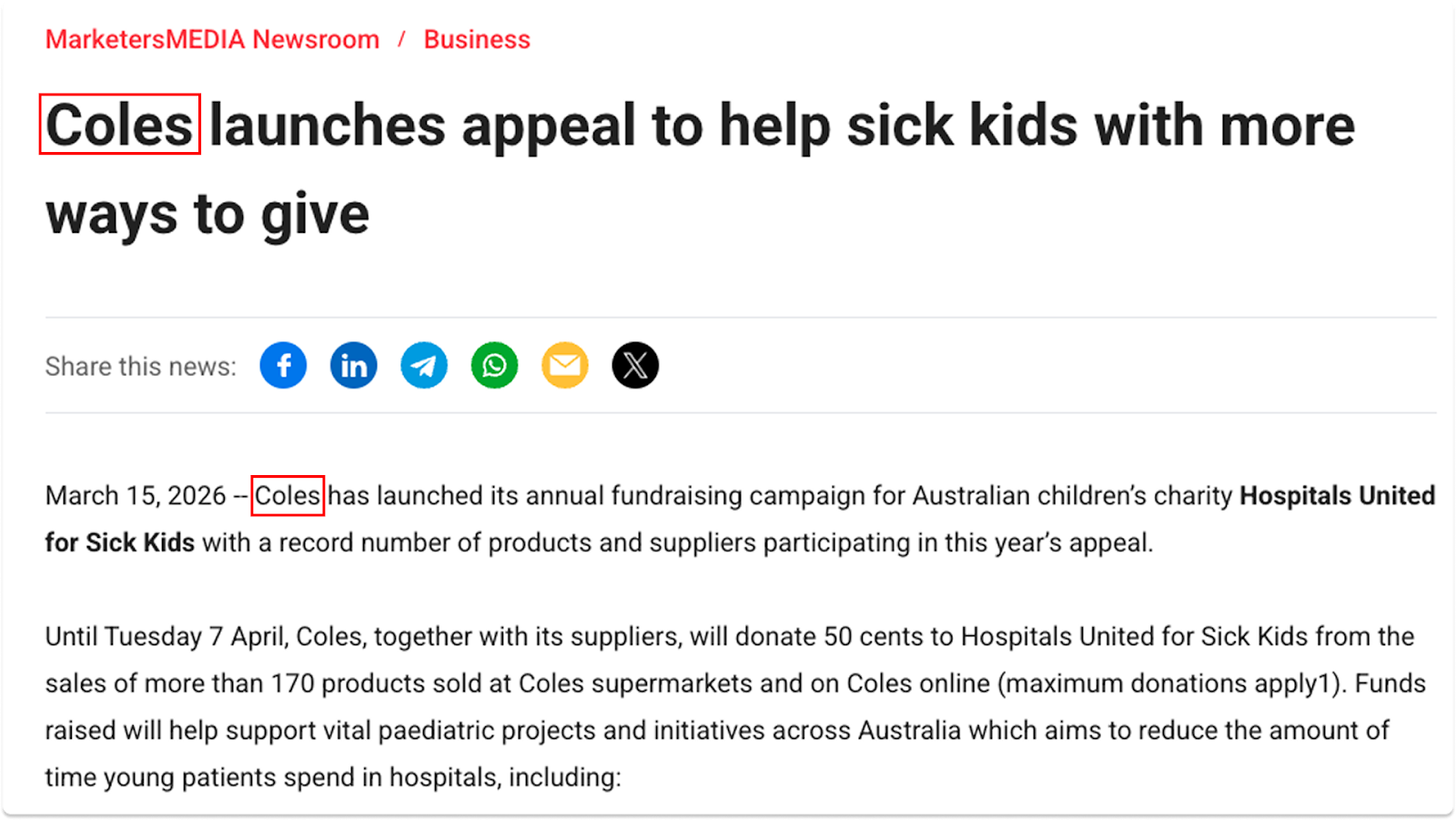
Example of third-person writing in a corporate announcement where the organization (Coles) is presented as the subject and the narrator reports the event from an external perspective.
Third person comes in several forms depending on what the narrator knows:
For business and professional writing, the distinction between these subtypes is largely irrelevant.
What matters is that the third person positions the brand, product, or client as the subject, separate from the reader, separate from the author.
Want your brand story featured on credible media outlets?
MarketersMEDIA Newswire helps you get the kind of third-party visibility these big brands achieved—through press release distribution to established publications. Get in touch with us today.
| Aspect | Second Person | Third Person |
| Core pronoun | You / your | He / she / they / it |
| Reader relationship | Direct, intimate | Observational, distanced |
| Typical use cases | Marketing copy, tutorials, UX writing | Press releases, case studies, news |
| Tone effect | Personal, action-oriented | Formal, credible, objective |
| Fiction use | Rare, experimental | Most common (omniscient, limited) |
| Academic writing | Generally avoided | Standard and preferred |
The second person writing is strongest when the goal is to make the reader feel that the content is about them, it can be about their:
Landing pages, email campaigns, and sales letters almost always benefit from second person.
The reader needs to picture themselves using the product, solving the problem, or achieving the result.
“You” language closes the psychological distance between the offer and the reader’s reality.
Second person copy: When your announcement goes live on hundreds of media outlets, your brand’s visibility doesn’t just grow, it compounds.
Instructional content naturally uses second person because it’s written for someone carrying out an action.
Telling someone what “the user” should do instead of what “you” should do creates unnecessary friction and makes instructions feel detached.
Email is a one-to-one medium, even at scale.
Second person keeps that register. A broadcast email that refers to recipients in the third person reads as an announcement rather than a message.
The shift matters.
Interface copy, including button labels, onboarding prompts, and confirmation messages, should speak to the person using the product.
“Your report is ready” is clearer and warmer than “The report has been generated.” Second person keeps product writing human.
Third person writng is appropriate whenever objectivity, formality, or media credibility is the goal. The format signals that the content is reportable, not a pitch, not a personal opinion.
This is non-negotiable. Press releases are always written in third person.
They are written to be picked up, republished, and referenced by journalists and media outlets.
A press release that addresses the reader as “you” breaks the format convention immediately and signals to journalists that the content was not written for media distribution.
The company, product, or person being announced is the subject. The journalist or outlet reading the release is not addressed directly.
For example:
Correct press release POV: MarketersMEDIA Newswire today announced expanded distribution access to over 500 media outlets across North America, giving brands wider reach for time-sensitive announcements.
Incorrect press release POV: You can now reach over 500 media outlets across North America with your announcements.
Case studies document what a named client achieved.
Third person keeps the focus on the customer’s story, their challenge, what was implemented, and the measurable result.
The brand tells the story from the outside, which adds credibility.
A case study that shifts into second person suddenly reads like the customer is being told what they experienced, which undermines authenticity.
Example of third-person writing in a case study by MarketersMEDIA Newswire, where the company is described from an external perspective rather than addressing the reader directly:

Academic writing avoids both first and second person in most contexts.
The third person POV maintains the neutral, evidence-based register that formal research requires. The research findings are the subject, not the researcher, not the reader.
Both formats signal authority through objectivity.
Third person positions the content as reporting on a trend, a finding, a development rather than as a recommendation directed at the reader.
Whitepapers that shift into second person start to read like sales collateral, which undercuts the authority the format is designed to build.
Most grammar guides frame second vs third person as a creative writing decision.
For marketers and PR professionals, the stakes are different. The wrong POV choice doesn’t just feel off. It breaks the format, misses the audience, or disqualifies content from being syndicated.
Here’s a practical framework:
| Content Type | Correct POV |
| Press release | Third person |
| Landing page / sales page | Second person (the reader is the subject) |
| Email broadcast | Second person (one-to-one register) |
| Case study | Third person (tells the client’s story) |
| Blog post / educational content | Second person or third person (context-dependent) |
| Whitepaper / research report | Third person (authority depends on objectivity) |
| Product how-to / onboarding | Second person (the user is doing the action) |
| Social media post | Second person or third person (platform-dependent) |
The practical rule: if the content is meant to be syndicated, published as news, or referenced as a credible source, use third person. If the content is meant to prompt a specific reader to feel, decide, or act, use second person.
The most common mistake in press release writing.
Second person signals promotional intent and breaks the journalistic format that media outlets expect.
Journalists need to be able to republish content directly. A press release addressed to “you” cannot be syndicated without rewriting.
Switching between second and third person mid-document creates tonal confusion.
A blog post that opens with “when you’re writing a press release” but later refers to “the client” and “the brand” without explanation feels disjointed.
Choose one dominant POV and use the other only when the context explicitly requires it.
Landing pages need conversion.
Third person distances the reader from the offer. Instead, you need to use the second person POV where the copy speaks directly to the reader to encourage action.
For example:

Second person can be formal.
Professional instructional documents, compliance guides, and legal notices frequently use “you” while maintaining a formal register.
POV and tone are separate decisions.
Second person and third person are not interchangeable stylistic preferences.
Each serves a defined purpose. Third person builds authority and media credibility. Second person creates immediacy and draws the reader into the content.
For press release writers and PR professionals, the line is clear: press releases are always third person.
Writers who want to see how this works in practice can review standard press release examples and templates to understand how third-person POV is applied throughout a release.
For marketing copywriters, the preference is almost always second person. Place the reader at the center of the story, the offer, and the outcome.
The most common professional writing errors come from applying the wrong POV to a format that has a clear convention. Knowing which to choose and why is a basic competency for anyone producing content that needs to perform.
A: In most marketing contexts, yes. Second person creates directness and makes the reader the subject of the benefit or action. Third person is more persuasive in contexts where credibility and objectivity do the work. Whitepapers and case studies, for example, persuade through authority rather than intimacy.
A: Yes, but intentionally. A case study might use third person to tell the client’s story and shift to second person in the final CTA to prompt the reader to act. The shift should be deliberate and signaled by a clear transition, not accidental drift.
A: Because press releases are written to be republished. A journalist receiving a release needs copy they can quote, excerpt, and syndicate directly. Second person copy that addresses “you” cannot be reproduced without editing. Third person keeps the content journalist-ready and format-compliant.
A: First person (I, we) works well in founder narratives, thought leadership bylines, and personal essays. It builds authenticity and signals direct accountability. For formal business content including press releases, case studies, and research reports, first person is generally inappropriate. For brand content, it depends on whether the brand speaks as an entity (‘We believe…’) or remains narrator-neutral.
A: Not directly. Google evaluates relevance, depth, and user experience, not the POV used to deliver content. That said, POV affects readability and engagement, which influence time-on-page and behavioral signals that do feed into search quality assessments.


 PR playbook to get your brand cited in AI answer
How to check and fix what AI says about your brand
2 minutes checklist to make your PR AI-friendly
PR playbook to get your brand cited in AI answer
How to check and fix what AI says about your brand
2 minutes checklist to make your PR AI-friendly