New Media Unlocked!
You can now publish on USA TODAY through MarketersMEDIA. That's 142M+ monthly visitors and DR 92 backlinks for every release you publish.
Better reach, better SEO, better credibility.

You can now publish on USA TODAY through MarketersMEDIA. That's 142M+ monthly visitors and DR 92 backlinks for every release you publish.
Better reach, better SEO, better credibility.
Table of Content


Press releases are an important part of any public relation campaign.
Being involved in both PR and Internet Marketing for almost a decade and running MarketersMEDIA Newswire, as a CEO, I have the opportunity to see the commonalities of great and effective press releases.
Great press releases share the same fundamentals. Poor ones make the same mistakes.
The gap between the two is rarely about the news itself. It is almost always about execution.
PR has shifted significantly since social media took hold. Fax and phone calls became Twitter, online newsrooms, and instant exposure.
For online businesses writing a press release in 2026, that shift created new demands.
Your release needs to be discoverable by search engines, referenced by AI systems, and published on credible media domains to do its full job.
Online businesses often underestimate what a published press release does beyond media pickup.
When your release is distributed through an established newswire and published on reputable media domains, it creates something a social media post never can: a stable, indexed, authoritative reference point for your brand.
Search engines crawl it. Journalists use it as background. AI systems pull from it when building responses about your company or industry.
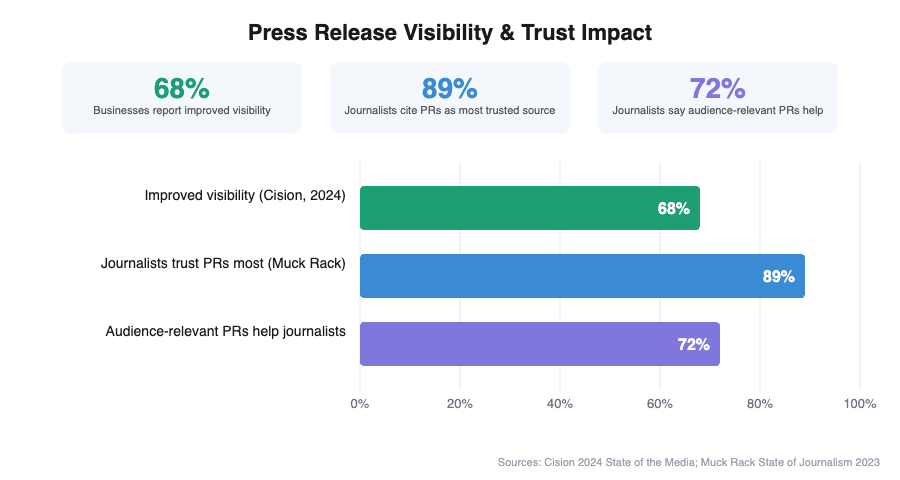
68% of businesses report improved visibility after publishing press releases.
This figure reflects the compound effect of your brand appearing on trusted domains.
The visibility impact of press releases on businesses that regularly distribute them:
For an online business, this matters in three specific ways:
Press releases are not a relic. They are a precision tool. Used correctly, they build the kind of third-party credibility that owned content simply cannot produce on its own.
The most common reason a press release gets rejected or ignored is not poor writing. It is poor newsworthiness.
For online businesses, identifying what qualifies as news takes deliberate thinking. Not every company update is a story.
The test is simple: would a journalist covering your industry consider this relevant to their readers?
Strong candidates for a press release include:
What does not qualify: a routine sale, a minor website update, a social media milestone, or anything that is promotional rather than informational.
The rule is: if you would not pitch it to a journalist, do not write a press release about it.
If you are struggling to identify your newsworthy angle, it helps to know what journalists actually look for in a story before you write a single word of your release.
Press releases follow a standard format. Editors and journalists expect it. Deviating from it signals inexperience and reduces your chances of pickup.
Every press release should include these elements, in this order:
For ready-to-use structures, press release templates can help you apply this format correctly from the start rather than reverse-engineering it from scratch.
In my experience reviewing thousands of press releases, the headline is where most online businesses lose the game before it starts.
Your press release headline is doing two jobs at once. It has to hook a journalist into reading further, and it has to carry your primary keyword for search indexation.
More than 50,000 headlines are published every day. The releases that stand out follow a few non-negotiable rules:
If the name is someone significant, put it in the headline. If the topic is trending, lead with the keyword.
If it is a major brand, capitalise it. People stop scrolling for names they recognise.
Many press release wires and news systems also pay heavy algorithmic attention to the keywords within a headline. Writing well is not just for the journalist reading it.
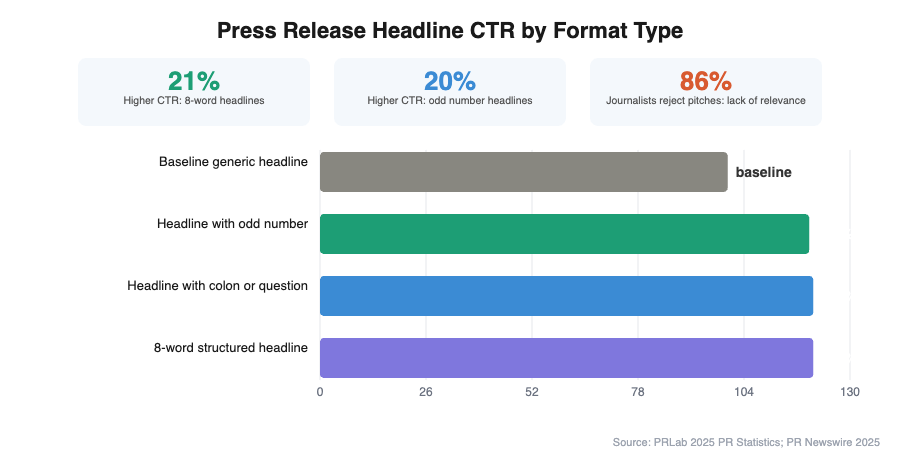
Headlines that include odd numbers, a colon, or a question phrasing see up to 21% higher click-through rates than average, a meaningful edge when your release is competing with hundreds of others on the same day:
I always tell people: write your press release as if the reader will only see the first paragraph. Because most of the time, that is exactly what happens.
Editors at major outlets decide very quickly whether a story is worth pursuing. Most readers never get past the opening.
Everything that matters has to sit right there at the top:
This is the inverted pyramid structure in practice:
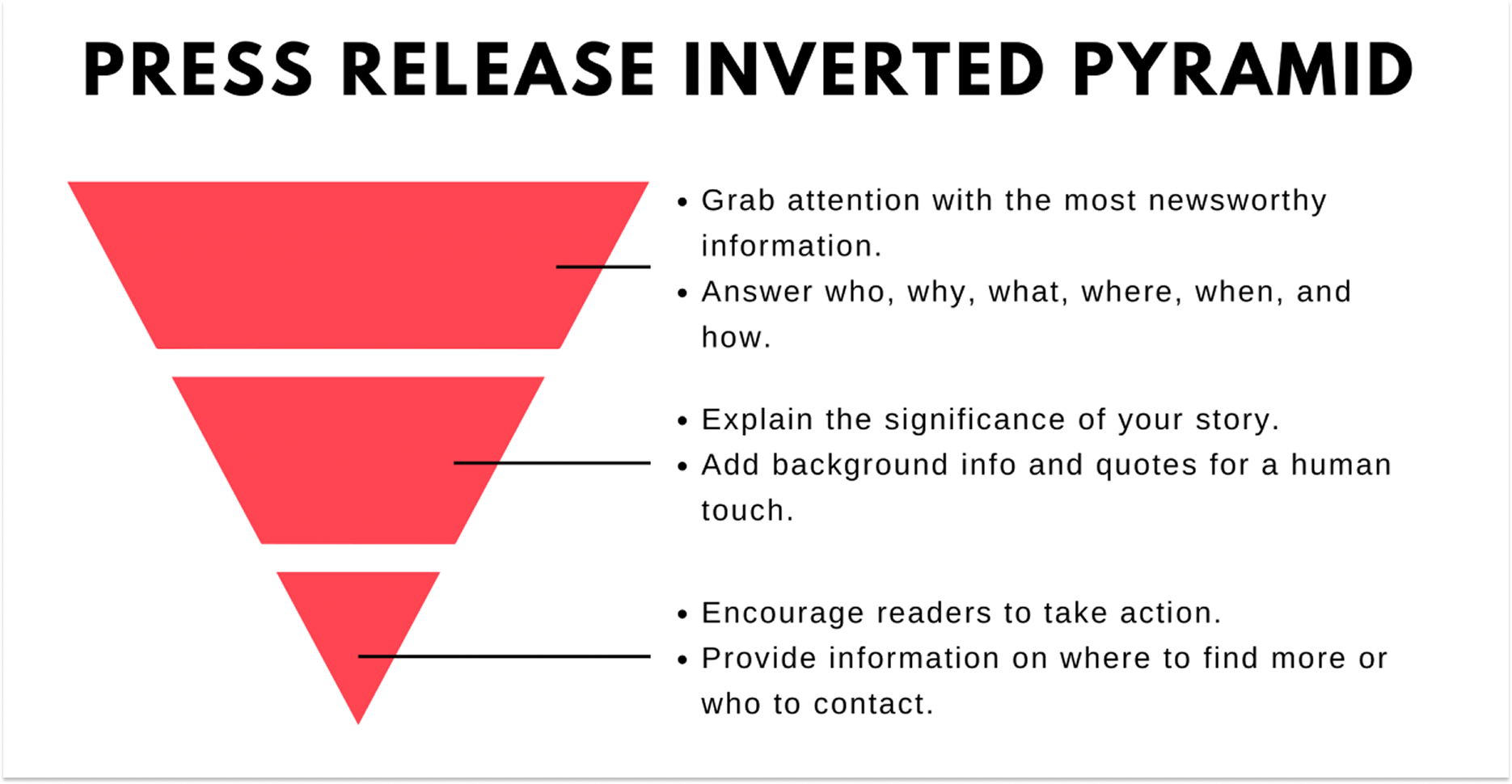
Lead with the most important information, let the body provide supporting detail. Never bury the news in the third paragraph.
If you do SEO, put a relevant link in the first paragraph. Many republications use the first paragraph as the excerpt, which means your most important value gets surfaced upfront.
One thing I have noticed after years of running a newswire: people actually read quotes inside the press release.
They want to know what someone actually said, not what a PR team approved.
Many times, content can be repurposed or worded into a conversation. Make it sound like an interview or a Q&A.
A well-placed quote gives a human voice to the announcement.
Journalists frequently lift quotes directly when writing their coverage. A strong quote from a founder or executive can become the centrepiece of a third-party article.
Write quotes that sound like something a person would actually say, not a sentence that reads like it came from a company statement:
| Weak Example | Strong Example |
| We are pleased to announce the launch of our new platform, which represents a significant advancement in our product roadmap. | We built this because our customers kept telling us the same thing: they needed faster access to data without the technical overhead. This solves that. |
One sounds like a legal disclaimer. The other sounds like a founder who believes in what they built.
For the body paragraphs beyond the lead, follow this sequence:
Keep body paragraphs short. Two to three sentences per paragraph. Online readers scan before they commit to reading in full.
This is the step most online businesses skip, and it is the one that has changed the most since I started in this industry.
A press release published on a high-authority domain creates two compounding assets: an indexed page that search engines can rank, and a credible source document that AI systems can cite when generating responses about your brand or industry.
To maximise both, here is what I recommend:
Search algorithms and AI retrieval systems both weight early keyword placement heavily.

Use press releases to get your brand mentioned and recommended by ChatGPT, Gemini, and Perplexity when people search.
 PR playbook to get your brand cited in AI answersHow to check and fix what AI says about your brand2 minutes checklist to make your PR AI-friendly
Where would you like to receive the AI PR toolkit:
A link within your release pointing back to your website or product page passes authority and drives traffic when the release is indexed.
Keep to one or two links maximum.
Warning: more than that can trigger spam filters on distribution platforms.
AI systems process structured, factual content more reliably than vague promotional language.
Statements like “Company X raised $5M to expand into three new markets” are more likely to be cited accurately than “Company X is transforming the way businesses operate.”
Your company name, location, dates, key figures and people should be included so search engines and AI models can quickly understand what your press release is about.
When writing, you need to be intentional with your keywords and links so your press release is easier to find and supports your SEO efforts.
You can also get your press release published on trusted domains to boost your AI search visibility and help your brand show up in LLM generated answers.
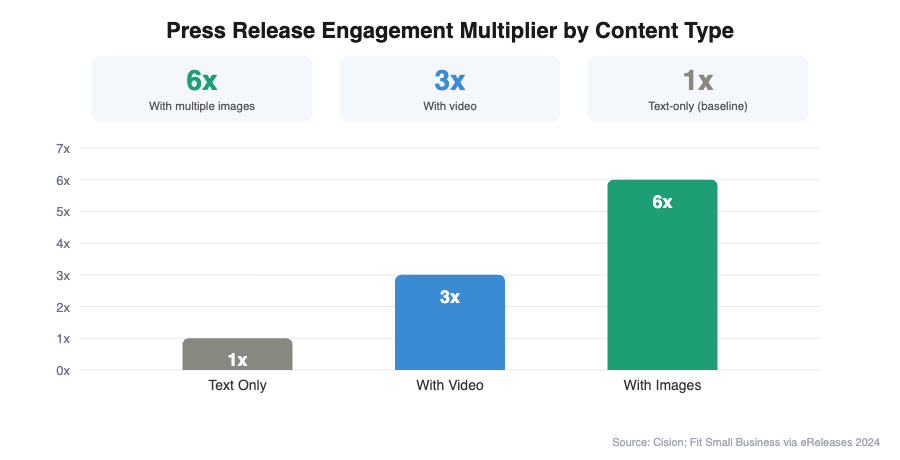
Text-only press releases leave engagement on the table. We have seen releases with photos, infographics, and video get significantly more views than those without.
Your readers are human.
They see a catchy headline, they click, and the next thing they expect is a photo. That is a golden opportunity to reinforce your most important message visually.
Press releases with multiple images generate 6x more engagement than those without:
67% of journalists use images more than any other media type when working with press releases.
Releases that include video can generate 3x more engagement than text-only versions.
For online businesses, this is a straightforward opportunity.
You already have brand assets, product screenshots, founder photos, and graphics.
Include at least one relevant image in every press release you distribute following the practical guidelines as follows:
A media kit page on your website, containing logos, headshots, approved imagery, and a company overview, also makes it significantly easier for journalists to cover your story without having to chase you for assets after the fact.
The biggest mistake I see online businesses make is treating a press release as a one-time event.
I have spotted companies running releases as frequently as blog posts. They work.
Each release becomes a development of the previous one. Chain the stories, connect the narrative, and your brand builds a consistent media presence over time.
Do not put an end to your first release. Keep issuing more, each one a step forward from the last.
Running a press release campaign with planned follow-up releases is far more effective than a single isolated announcement.
In my experience, one of the fastest ways to improve a press release is to add real numbers.
Like how many years the business has been operating, serving how many customers in how many countries, reaching how much revenue. Those details make a release tangible in a way that descriptive language never can.
Almost 95% of all professional journalists write with numbers in 99% of their stories. That is not a coincidence.
Hard numbers give journalists something concrete to report. They also give readers something to remember.
Releases containing hard numbers get referenced significantly more often than those that rely on vague claims. If the number exists, it belongs in your release.
Do not write “our platform has seen strong growth.” Write “our platform grew from 3,000 to 18,000 active users in 12 months.”
One specific. One verifiable. That is the difference.
Here is what a journalist thinks the moment your release catches their attention: “Okay, I am pitched. Now where is everything I need to run this story?”
Thank God you have a media kit page that has everything they need.
Logos. HD videos. High-res photos. A story outline. Variations and preamble. Your background. Your quotes. And most importantly, your permission to use them in their story.
Without that page, the journalist has to chase you. And journalists who have to chase sources often find a different story to run instead.
Build your media kit page before your first release goes out. Keep it updated every time your brand, team, or product changes.
Make it easy to find on your website.
The easier you make a journalist’s job, the more likely they are to cover you.
Make sure your press release includes all of these elements before you start distributing it.
Distribution determines whether your press release reaches the right outlets that can actually build credibility for your brand.
If it only appears on low-quality or irrelevant sites, it won’t have much impact.
But when it’s published on trusted and recognized platforms, it helps strengthen your brand’s reputation and makes your business look more credible to both people and search engines.
Online businesses have three main distribution paths:
A press release distribution service syndicates your release across a network of news sites, financial portals, media databases, and aggregators.
This is the fastest route to broad coverage on credible domains.
The quality of the outlets matters more than the quantity. A release published on AP News, Business Insider, Yahoo Finance, and USA Today carries far more weight than one spread across hundreds of low-authority directories.
Identifying journalists who cover your industry and sending a personalised pitch alongside the press release.
This requires building and maintaining a media contact list.
It takes longer to execute but can result in deeper, more editorial coverage. For guidance on the pitch itself, the press release email pitching breakdown covers subject lines, structure, and personalisation tactics.
Publishing the press release on your own newsroom page, sharing it via email newsletter, and posting across your social channels is a MUST.
This does not replace newswire distribution but amplifies it, giving your existing audience access to the announcement while the newswire handles external reach.
For most online businesses without existing media relationships, newswire distribution is the most reliable starting point.
It guarantees publication on established domains, creates indexed URLs that build long-term authority, and generates the PDF and live-link proof of publication that clients and stakeholders expect.
MarketersMEDIA Newswire distributes to outlets including AP News, Business Insider, Yahoo Finance, and USA Today, with editorial review built in to protect publisher relationships and improve your approval rate.
A press release written well and distributed through the right channels is one of the few content formats that creates lasting, compounding value for an online business.
It gets indexed by search engines, cited by AI systems, and picked up by journalists who give your brand third-party credibility that owned content alone cannot build.
The key is to combine disciplined writing (lead with the news, keep it factual, include a human quote) with a distribution strategy that puts your release in front of the outlets that actually move the needle.
If you want your press release published on high-authority outlets like AP News, Business Insider, Yahoo Finance, and USA Today, MarketersMEDIA Newswire handles the distribution infrastructure so you can focus on the story. Get in touch with us today!
A: The optimal length for a press release in 2026 is 400 to 500 words. That is long enough to include the headline, lead, two to three body paragraphs, a quote, a boilerplate, and contact details, and short enough to hold a journalist’s attention. Avoid padding beyond 600 words unless the announcement genuinely requires additional context.
A: There is no fixed cadence, but consistency builds more authority than occasional bursts. Businesses that publish one press release per month maintain a steady flow of indexed media references that accumulate over time. Publishing in response to genuine news, rather than manufacturing reasons to send a release, is what sustains media relationships and editorial credibility.
A: Press releases do not directly improve Google rankings in the way traditional backlinks do. What they do is create brand mentions and indexed references on authoritative domains that contribute to your overall brand authority signals. Combined with consistent distribution, they support long-term search visibility rather than providing a short-term ranking spike.
A: A press release is a formal announcement written for journalists and media outlets. It follows a strict structure, uses third-person perspective, and is designed to be picked up and reported on. A blog post is owned content written directly for your audience. Both serve different roles in a content strategy. For a deeper comparison, this breakdown of press releases vs blog posts explains when to use each format.
A: Yes, and for online businesses without dedicated PR writers, an AI press release generator can significantly reduce the time it takes to produce a well-structured first draft. The key is reviewing the output for accuracy, adjusting the tone to match your brand voice, and ensuring it meets the editorial standards of your chosen distribution platform before submission.


 PR playbook to get your brand cited in AI answer
How to check and fix what AI says about your brand
2 minutes checklist to make your PR AI-friendly
PR playbook to get your brand cited in AI answer
How to check and fix what AI says about your brand
2 minutes checklist to make your PR AI-friendly