New Media Unlocked!
You can now publish on USA TODAY through MarketersMEDIA. That's 142M+ monthly visitors and DR 92 backlinks for every release you publish.
Better reach, better SEO, better credibility.

You can now publish on USA TODAY through MarketersMEDIA. That's 142M+ monthly visitors and DR 92 backlinks for every release you publish.
Better reach, better SEO, better credibility.
Table of Content


We are wired for stories. We listen to them, we tell them, and we use them to make sense of the world around us.
Long before anyone cared about features, pricing, or market share, people were already sharing stories to explain who they were and what they stood for.
Brands are no different.
Every company, whether it realizes it or not, is already telling a story. The only real question is whether that story is intentional, clear, and worth paying attention to.
A strong brand story is one of the most powerful tools you have for making people care about what you do, because they remember how you made them feel.
That emotional memory is what turns a brand from something you recognize into something you choose.
In a world of endless content and limited attention, the stories that last are not the loudest or the most polished. They are the ones that feel human.
In this post, we will look at what brand storytelling really is, why it works, and 7 examples that made people feel something real, along with the lessons you can use for your own brand.
Brand storytelling is not your origin story. It’s not “Founded in 1987 by two brothers in a garage”.
Brand storytelling is the strategic use of narrative to create emotional associations between your brand and your customer’s identity or aspirations.
Traditional advertising says: “Here’s our product. Here’s why you should buy it.”
Brand storytelling says: “Here’s who you could become. Our product is the tool that gets you there.”
The difference drives real business outcomes. Emotional memory turns recognition into preference. People choose brands they feel connected to, not just brands they know about.
For example, when Dove tells stories about real women and beauty standards, it is not really talking about soap at all.
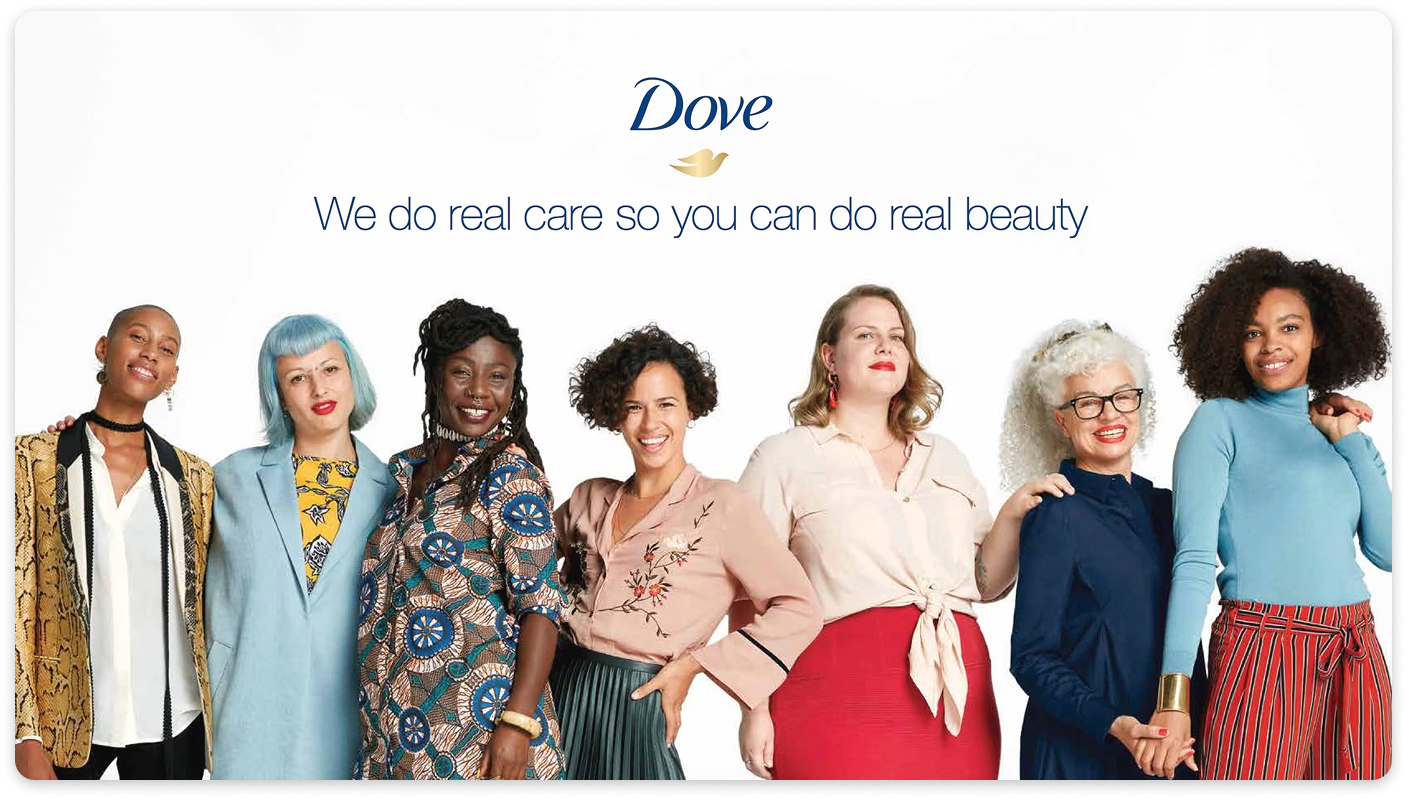
It is telling a story about confidence, self image, and how people see themselves in the mirror. The product is there, but it is not the point.
Humans like to think they make rational decisions. We compare features, read reviews, check prices, and weigh pros and cons.
But research in behavioral psychology tells a different story. Most decisions are made emotionally first, then rationalized afterward. We feel our way to a choice, then find logical reasons to support it.
This means that if your brand can create a positive emotional response such as trust, warmth, humor, or inspiration, you have already done most of the selling. The features and price simply confirm what the emotion already decided.
Think about a brand you love. Now try to remember the specific product specifications that made you choose them.
That is usually hard.
Now think about a campaign from that brand that made you feel something. That is much easier because human memory is built around narrative.
Our brains are wired to store and recall stories more effectively than lists of facts. When information is presented as a story, people retain it far better than when it is presented as data points alone.
That is why “our formula contains 30 percent more hydrating molecules” does not stick, but “a young woman finally feels confident wearing a swimsuit for the first time” does.
In crowded markets, features converge. Two competing products often do roughly the same thing at roughly the same price. Differentiation on product alone becomes difficult.
Story is what separates you.
When a brand consistently tells stories that feel authentic, human, and aligned with real experiences, it builds something no competitor can easily copy. It builds a relationship.
Relationships build trust. Trust builds loyalty. Loyalty builds long term revenue.

For example, Nike and Adidas both sell sportswear, but they tell very different stories.
Both brands sell similar products. The difference is the story they choose to tell, and the kind of emotional connection they want to build.
Great brand stories share a few common traits:
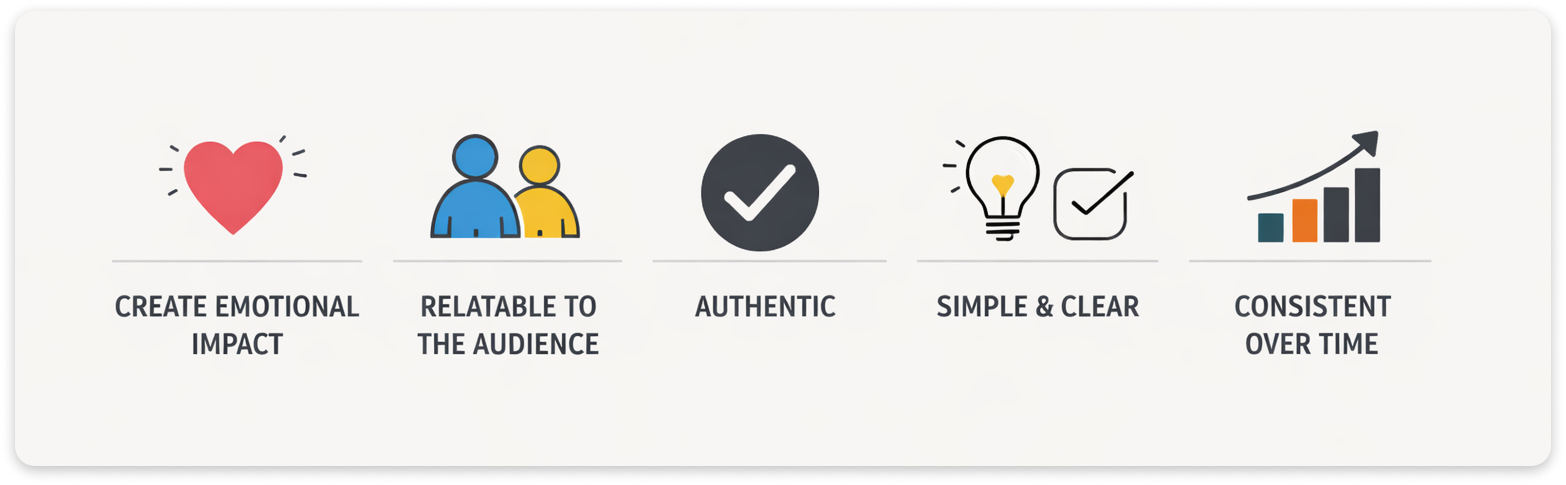
A great brand story makes people feel something. It might be warmth, inspiration, humor, or reassurance, but there has to be an emotional hook.
Without emotion, there is nothing for the audience to remember.
The best stories are not about companies or products. They are about people.
When the audience can see themselves, or someone they care about, in the story, the message becomes personal instead of abstract.
Audiences can usually tell when a story is forced or manufactured. A great brand story reflects something true about the brand and the customer’s experience.
If the story does not match reality, trust breaks down quickly.
The most effective stories are easy to follow and easy to retell. One character. One challenge. One outcome. One main feeling. Simplicity is what makes a story stick.
A single good story can make a strong campaign. But a consistent pattern of stories, told with the same values and emotional direction over years, is what turns a campaign into a brand.
Over time, these stories compound.
One great story can create attention. A consistent stream of great stories is what builds recognition, trust, and long-term loyalty.
Start with your customers.
Look at their problems, their goals, and the moments where your product or service actually makes a difference.
The right story is usually already there, in customer support tickets, testimonials, sales calls, and real world use cases, and you just need to notice it.
Your hero should look like your real customer, not an idealized version of them.
The more human and specific the character feels, the more people will see themselves in the story.
Counterintuitively, the more specific your hero is, the more universal the story becomes.
For example, Nike rarely shows perfect, untouchable athletes who never struggle. Instead, many of its campaigns focus on people who are tired, unsure, or pushing through self-doubt.
The hero is not “the best athlete in the world.” It is someone trying to finish one more mile, lift one more rep, or show up one more day.
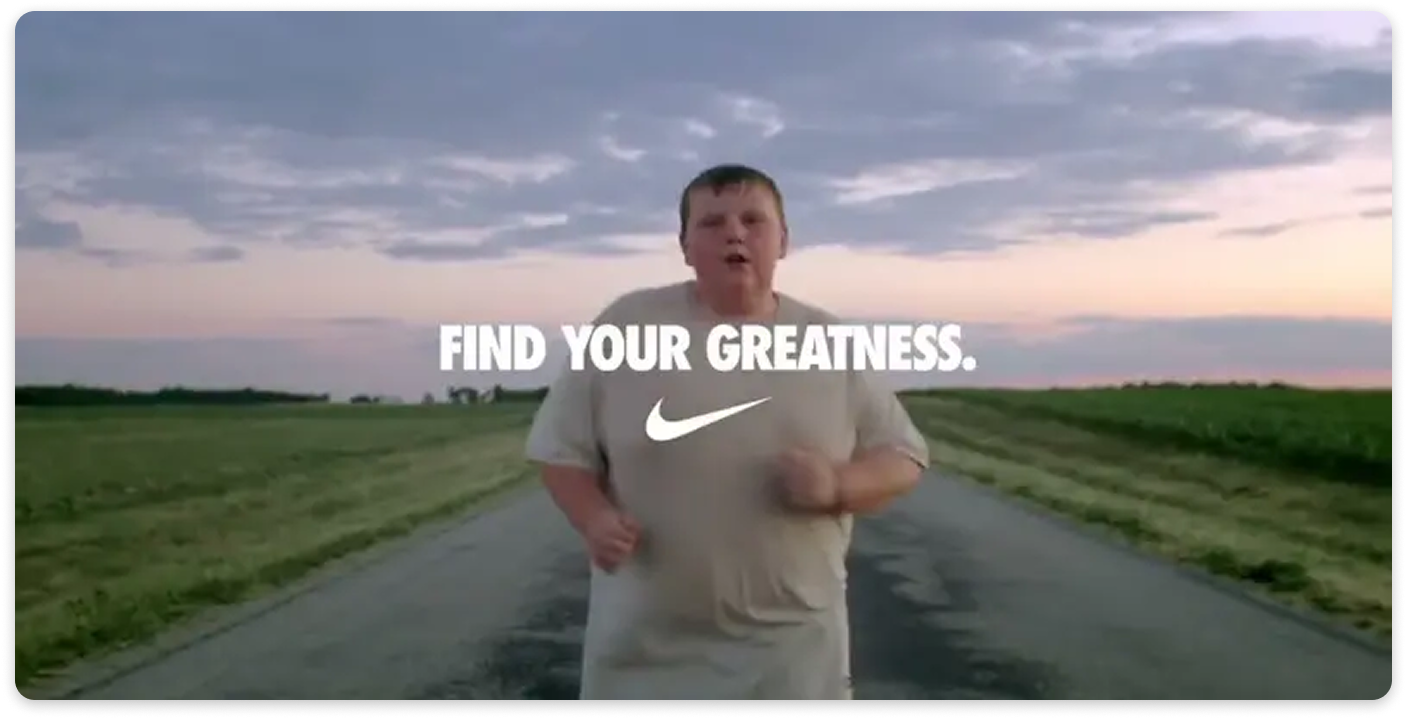
That makes the story feel familiar, even to people who are not professional athletes.
What does your hero want? Not what you want to sell—what THEY want to achieve or become.
Nike’s hero doesn’t want shoes. They want to prove they’re not a quitter. Glossier’s hero doesn’t want makeup. They want to feel like themselves, enhanced.
The conflict is the obstacle in the hero’s way.
In brand storytelling, this is usually the problem your product exists to solve, but it should be framed from the customer’s point of view, not the product’s.
For example, Glossier does not sell makeup by talking about coverage percentages or technical formulas. Instead, it starts with a very real conflict many customers feel: feeling overwhelmed by heavy makeup routines, or frustrated that products never feel like “you.”

Glossier’s storytelling centers on the desire for beauty products that enhance natural features without masking them, and the frustration of trying products that feel too heavy, too complex, or not like “real skin.”
The product only enters the story as the tool that resolves that tension. The conflict is not a better foundation formula.
The conflict is the experience of feeling less than your best because your makeup routine feels complicated or unnatural.
The audience connects with the real problem. When you start with the tension your customer actually feels, the story becomes human, relatable, and worth following.
This is the payoff. What does life look like after the hero encounters your brand?
The change does not have to be dramatic. It can be a small shift in confidence, a moment of relief, or a simple improvement in daily life.
What matters is that it feels earned and believable.
One hero. One problem. One outcome. One main emotion.
If you try to include everything, the story loses its impact. The stories that travel the furthest are the ones that are easiest to understand and retell.
A brand story is not written once and forgotten. As your product, market, and customers evolve, your stories should evolve too.
Your core values can stay the same. The way you express them should stay relevant.
That is the framework. Now let’s see how real brands use it in practice.
Google’s “Parisian Love” ad tells an entire love story using nothing but a series of search queries.
There is no voiceover and no celebrity. Just a search bar, changing over time, and a human life quietly unfolding. You watch someone search, learn, fall in love, move, and start a new chapter, all through the way they use Google.
What makes the ad so powerful is that the product is not being explained. It is being lived. You do not need anyone to tell you what Google does or why it matters.
You feel it through the story itself. By the end, you stop thinking of it as a product demonstration at all. It feels like a short film that happens to be told through a search engine.
IKEA’s famous “Lamp” ad starts by doing something unexpected. It makes you feel sorry for a discarded lamp.
The camera lingers. The music swells. You are led to care about an object that has been left behind on the street.
Then, just as the emotion peaks, the narrator breaks the fourth wall and tells you that feeling sorry for the lamp is ridiculous.
That sudden shift is the point. IKEA uses the very tools of emotional storytelling and then flips them on their head. In doing so, it makes a clear and memorable statement about its brand. Their products are affordable. You do not need to cling to old things. You can move on without guilt.
The story works because it makes you aware of how easily emotions can be triggered, and then uses that awareness to deliver the message. Sometimes, subverting the story is the story.
Apple’s “1984” Super Bowl ad barely shows a computer at all. Instead, it drops viewers into a bleak, uniform world where everyone looks and thinks the same.
That world is disrupted by one rebellious figure who breaks the system and introduces the idea of change.
Apple was not trying to explain what the Macintosh could do. It was trying to say what the brand stood for.
Creativity. Individuality. Resistance to conformity.
The product became a symbol of that belief rather than the center of the story. The reason this ad is still remembered decades later is that it sold an idea, not a feature.
When your brand represents something bigger than what you sell, that is often the story worth telling.
Pampers chose to tell a story about something most brands would rather avoid.
Dirty diapers. Messy moments.
The unglamorous side of parenting that everyone experiences but few talk about openly.
Instead of pretending those moments do not exist, the campaign embraced them with humor and warmth.
It showed parents that they were not alone in dealing with the chaos, the smells, and the everyday realities of caring for a baby.
That honesty is what made the story work. By normalizing a shared experience, Pampers made parents feel understood rather than marketed to. It is a reminder that some of the strongest stories live in the most ordinary moments.
Marks and Spencer did not try to convince people its food was better by listing ingredients or quality standards. Instead, it showed the food in a way that made you almost taste it through the screen.
Slow motion shots. Rich lighting. Close ups of texture and steam. A voiceover that made every bite sound indulgent.
The story was told through sensation. You did not need to be told the food was special. You could feel it.
This campaign shows how presentation itself can be storytelling. How you show something shapes how people think about it long before they ever try it.
In Mercedes Benz’s “Snow Date” ad, the focus is not really on the car. It is about a young couple trying to make it to their date on a snowy night.
The tension is human and simple. Will they make it in time?
The car does its job quietly in the background. It does not demand attention. It just makes the moment possible.
By the time the story ends, you do not remember a list of features. You remember the feeling of relief and warmth when they finally arrive.
The product does not have to be the hero to prove its value. Sometimes it is enough to be the reason the story has a happy ending.
Nike’s “Angry Chicken” ad turns an internal struggle into something you can see.
An athlete trains while a chicken follows him around, clucking and watching, representing doubt, fear, and resistance. The athlete keeps going anyway.
Anyone who has ever struggled to stay motivated understands that feeling immediately. The chicken is funny, but it is also uncomfortably accurate. It makes the invisible battle visible.
This is why the story works. Abstract emotions become powerful when you give them a shape and a presence. When people can see their own inner struggles on screen, they recognize themselves in the story.
Each of these stories works in its own way, but they succeed for many of the same reasons.
The focus is not on the product, the company, or the features. It is about someone’s life, feelings, or struggle.
That human focus is what makes the story easy to relate to and easy to remember.
It might be warmth, humor, nostalgia, motivation, or reassurance. But it is never everything at once.
By committing to a single emotional thread, the story stays focused and lands more strongly.
None of these campaigns try to explain every benefit or every feature. They tell one story, make one point, and leave one main feeling behind.
That simplicity is what makes them easy to retell and easy to recognize years later.
The brand is there to enable the moment, solve the problem, or make the outcome possible. The spotlight stays on the person in the story, not the product.
That alignment is what makes the storytelling feel honest rather than performative. Over time, that consistency is what builds trust.
And trust is what turns a good story into a strong brand.
That is the real power of brand storytelling. It is not about spending more or saying more. It is about telling the truth in a way people recognize and remember.
Your brand already has stories worth telling. They are in your customers’ experiences, your team’s work, and the small but meaningful differences you make in people’s lives.
The job is not to invent drama. It is to notice what is already true and tell it simply and honestly.
Do that well, and you are not just creating better stories. You are building something people can trust.
Start there. Keep it human. And make sure the right people are paying attention.If you want to turn that attention into real business impact, the next step is building brand awareness in a way that actually drives trust and sales.
A: Yes. In fact, smaller brands often have an advantage because their stories are closer to real customers and real founders. You don’t need a big budget. You need a clear point of view, a real customer problem, and a story that feels honest and specific.
A: A brand story should show up across multiple touchpoints, not just in ads. This includes your website, social media, sales pages, onboarding emails, PR, and even product messaging. The story works best when people keep encountering the same emotional thread in different places.
A: Content marketing is about what you publish. Brand storytelling is about the emotional and narrative thread that connects everything you publish. You can have a lot of content without a story, but you can’t have strong brand storytelling without consistent content to carry it.
A: Start with real customer experiences and real problems, not slogans. If the story doesn’t match what customers actually experience, it will feel forced. The safest approach is to document what’s already true and shape it into a clear narrative, rather than inventing something aspirational but disconnected.
A: Your core story should stay stable, but how you tell it should evolve as your market, product, and audience change. Most strong brands keep the same emotional foundation for years while updating the examples, formats, and campaigns around it.


 PR playbook to get your brand cited in AI answer
How to check and fix what AI says about your brand
2 minutes checklist to make your PR AI-friendly
PR playbook to get your brand cited in AI answer
How to check and fix what AI says about your brand
2 minutes checklist to make your PR AI-friendly



![24 Best Press Release Examples [For All Occasions]](https://marketersmedia.com/wp-content/uploads/2025/03/Press-Release-Examples-for-All-Occasions.png)