New Media Unlocked!
You can now publish on USA TODAY through MarketersMEDIA. That's 142M+ monthly visitors and DR 92 backlinks for every release you publish.
Better reach, better SEO, better credibility.

You can now publish on USA TODAY through MarketersMEDIA. That's 142M+ monthly visitors and DR 92 backlinks for every release you publish.
Better reach, better SEO, better credibility.
Table of Content


If you work in public relations, your portfolio is really important. It shows what you have actually done and what kind of results your work can bring.
In 2026, that difference matters more than ever.
When you apply for a PR job, hiring managers often have to look through hundreds of applications. Most candidates will have similar job titles on their resumes.
In the same way, when a company is looking for an agency or a consultant, they usually compare several options before deciding who to work with. And in many cases, those proposals sound very similar on paper.
So what actually makes you stand out? It’s your Public Relations (PR) Portfolio:
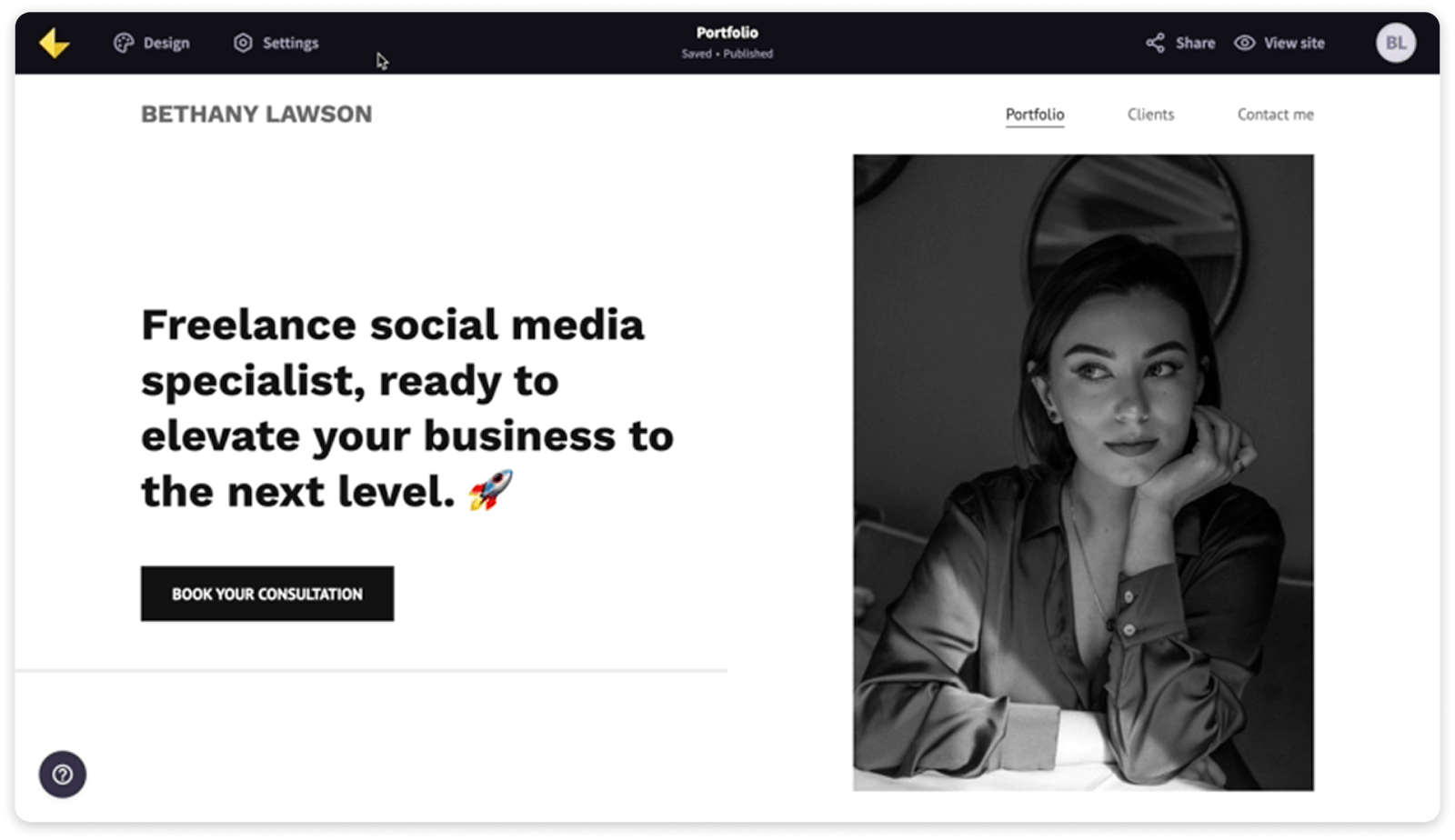
That is why people talk so much about PR portfolios. But the term does not always mean the same thing to everyone. So before getting into tools, structure, or examples, it helps to start with a simple question.
A PR portfolio is a curated collection of your best public relations work. It typically includes writing samples, campaign case studies, media placements, metrics, and anything else that shows you can actually do the job.
A PR portfolio is different from your CV and LinkedIn profile in a few key ways:
| Area | CV/LinkedIn | PR Portfolio |
| Content | Lists your roles, skills, and experience | Shows your actual work, such as press releases, campaigns, media coverage, and results |
| Context | Gives job titles and short descriptions | Explains the goal, your role, the approach, and what happened after |
| Format | Text-based profiles and summaries | A website built to present work with images, links, and case studies |
This difference is why PR portfolios have become more common in recent years. But not everyone uses one in the same way, and not everyone needs a PR portfolio for the same reasons.
Free Press Release Template
Get your free copy of press release template and advanced PR guide to run your press release.

The short answer is: it depends on your situation, but it almost always helps.
If you’re a freelance PR professional, a portfolio is essential.
When a potential client finds you online, they will evaluate you based on your portfolio. Clients can look at your past work, see how you approach campaigns, and understand the kind of results you help create.
This makes it easier for them to decide if you are a good fit for their needs. It also helps you stand out from other freelancers who only have a short profile or a list of services.
In practice, a good portfolio often becomes your main proof of experience. It supports your pitches, your proposals, and even simple introduction emails.
A portfolio isn’t always required for a salaried PR role, but it is increasingly expected at competitive agencies and organizations.
When two candidates have similar experience levels, the one with a portfolio that shows real campaign results almost always stands out.
Your portfolio also supports the rest of your application. A hiring manager who reads your cover letter and then visits a polished portfolio website is getting a far more complete picture of you than someone who only has a CV to go on.
Normally, hiring managers and clients will look at visual polish first: does this person present themselves professionally?
Then they look for strategic intent: did this person understand what the campaign was trying to achieve?
After that, they want measurable impact — actual numbers, not vague claims. And finally, they want to understand your process and how you work.
With that in mind, the next step is to look at what a strong PR portfolio should include.
Your portfolio needs to communicate three things clearly:
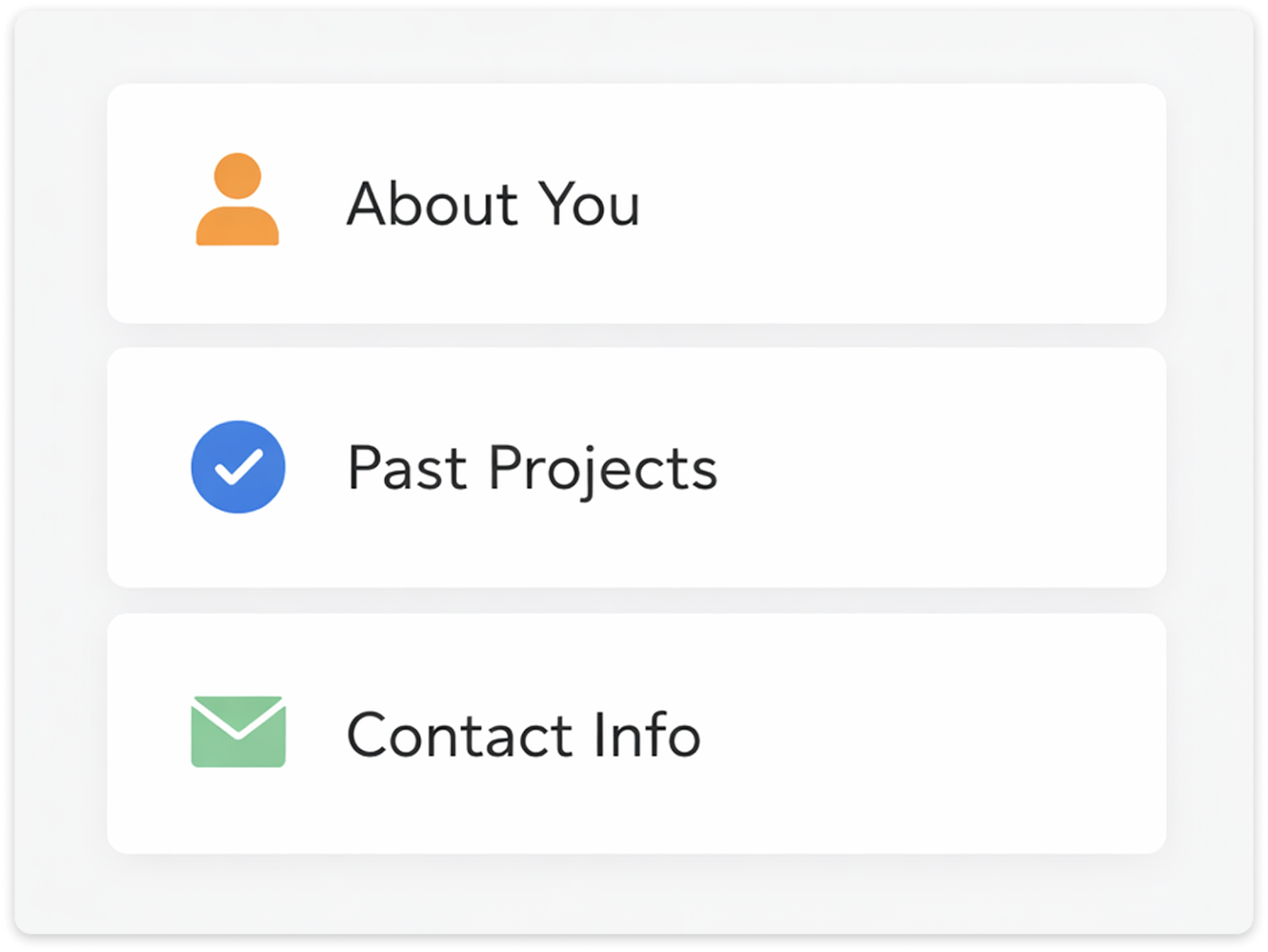
Your homepage is the first thing people see. It needs to immediately answer one question: Who is this person and what do they do?
Your homepage should include a clear headline with your name, your PR focus or specialization, and a short positioning statement that explains what makes you the right person for the job.
A professional photo and a few credibility signals, for instance:
Don’t overthink the headline. Something like: “PR Strategist Specializing in SaaS and Tech Brands | 8 Years of Earned Media Experience” is sufficient enough.
It tells a hiring manager or client exactly what they need to know in under ten seconds.
Your About page gives them the full picture. This is where you cover your professional background, the industries you’ve worked in, key achievements or certifications, and a bit of personal context that helps people feel like they know you.
Keep it scannable. You can make use of short paragraphs, clear hierarchy and no walls of text.
This is also a good place to link your resume as a downloadable PDF for people who want the formal version.
The most important thing to understand here is that your portfolio should focus on results, not just responsibilities.
Anyone can write “managed media relations” or “developed press release strategy.” That does not tell a hiring manager or a client whether your work actually made a difference.
What they really want to see is simple:
The easiest way to show this is to turn your work into clear project stories, not just a list of links or screenshots.
Each project should explain what the campaign was about, how you approached it, and what results it produced.
A strong PR project breakdown usually includes:
This is why case study pages work so well on a portfolio website. They let you present each project in a clear, structured way, with context, proof, and results all in one place.
Compared to PDFs or loose links, they are easier to browse, easier to update, and give you full control over how your work is presented.
Every page should have an easy path to contact.
Options include a footer with your email and LinkedIn profile, a dedicated contact page, or a contact form.
A direct email address is often more reassuring to clients than a form alone, because it feels more human and accessible.
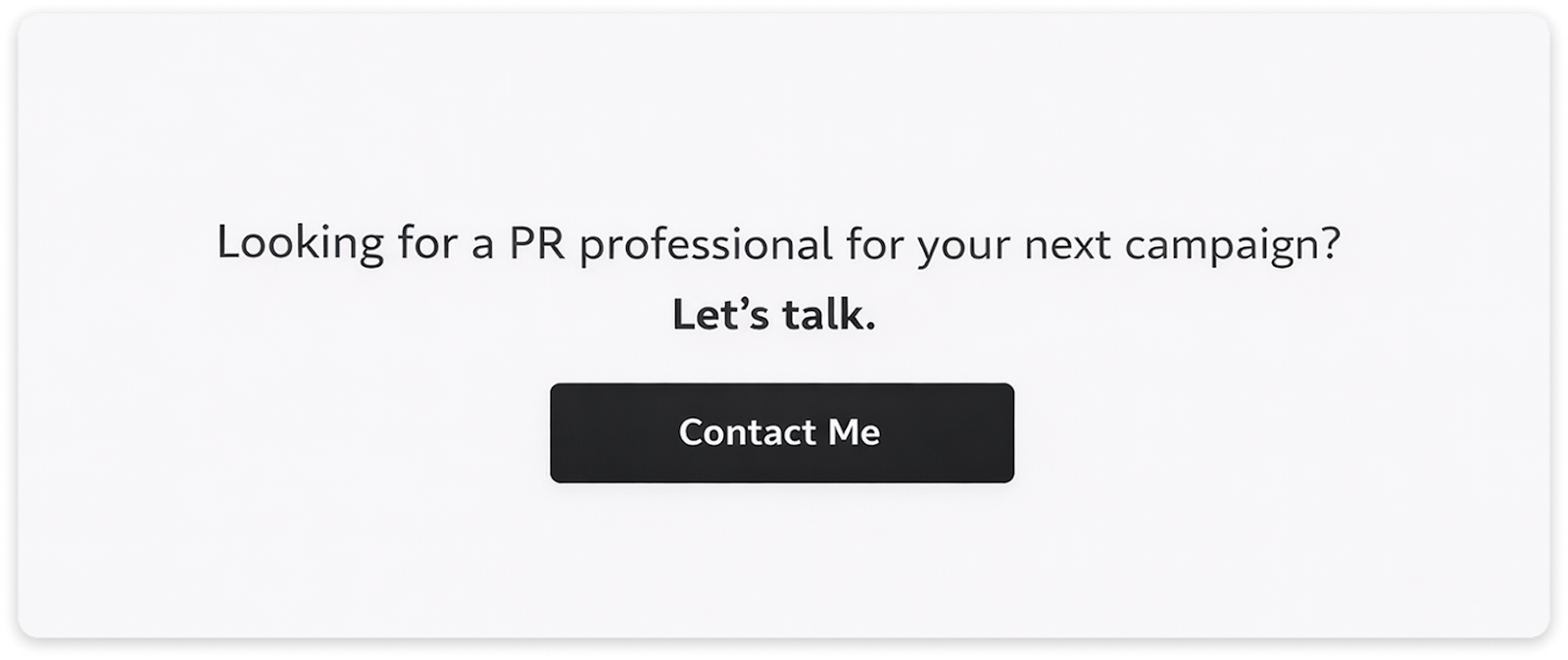
You can just end your portfolio with a clear call to action. Something simple like: “Looking for a PR professional for your next campaign? Let’s talk.” — with a direct link or button that will connect to your contact information.
For example:
Once you know what your portfolio should include, the next step is putting it together. The good news is that building a PR portfolio today is much easier than it used to be.
A portfolio website is almost always the best choice. It’s easy to share, looks professional, can be updated any time, and is accessible from any device.
Tools like Wix, Squarespace, and Copyfolio are all solid options.
If you want something fast with minimal setup, Carrd or Notion can also work for simpler portfolios.
PDFs can supplement your portfolio, but they shouldn’t replace the website. They go out of date quickly, can’t be tracked, and don’t make a strong first impression.
You don’t need to be a designer to build a good-looking portfolio. The most important thing is consistency. Pick one or two colors, stick to one or two fonts, and use them throughout.
Most portfolio platforms offer global style settings that let you set this once and apply it everywhere.
Keep the design clean and readable. The goal is for your work to stand out — not your design choices.
Common mistakes include too many fonts, low-contrast text, excessive animations, and cluttered layouts. Less is almost always more.
For each project, decide on the right format:
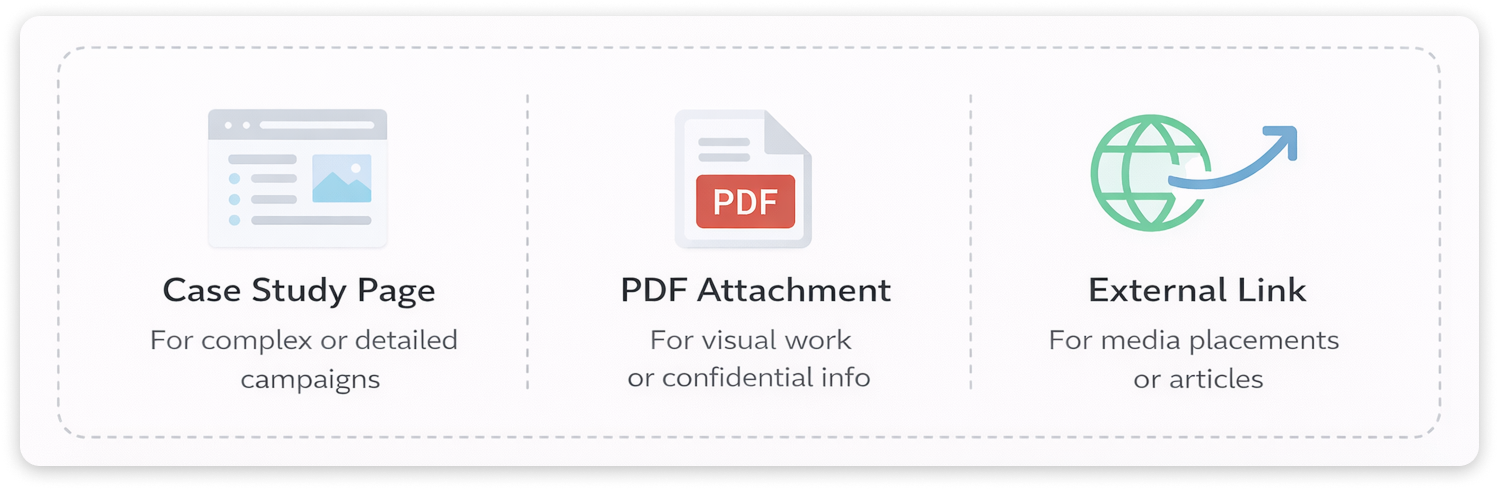
Structure each case study for scannability.
You can use a clear headline, short intro paragraph, then subheadings for goal, approach, execution, and results.
Pull out key stats or metrics as callouts. Use screenshots of media coverage, campaign assets, or press release placements to make it visual.
A custom domain is something like yourname.com or yournameandyourprname. It adds immediate credibility and makes your portfolio much easier to share.
Platforms like Wix, Squarespace, and Hostinger all make it easy to connect a custom domain at a low cost.
A generic portfolio URL (like yourname.wixsite.com) works in a pinch, but it signals that the portfolio might be a rushed job.
If you follow these tips, you’ll already be ahead of most people. But there are still a few common mistakes that can hurt an otherwise good portfolio.
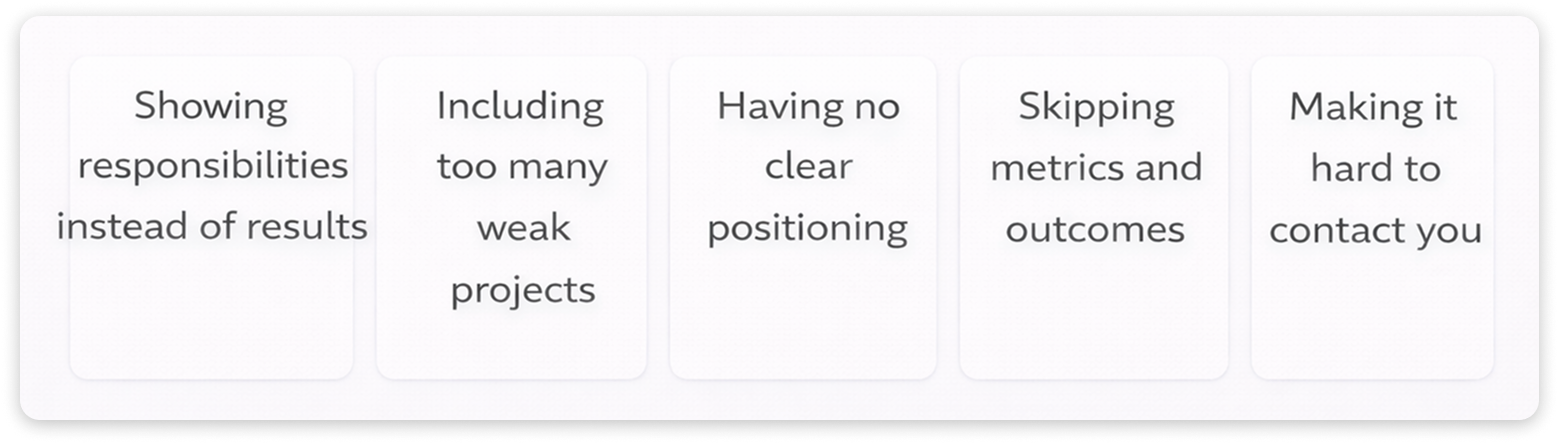
Phrases like “managed media outreach” or “worked on press releases” do not tell anyone if your work was effective. They describe tasks, not impact.
A better approach is to show outcomes. For example: “Secured 18 placements across national business and tech outlets in Q3, contributing to a 22% increase in website traffic.”
When writing your portfolio, always try to answer one question: what changed because of your work?
More is not better. Five strong case studies are much more convincing than fifteen average ones.
If a project does not show your best thinking, execution, or results, cut it. Your portfolio should be a highlight reel, not an archive.
If someone cannot tell within ten seconds what kind of PR you do and who you do it for, your homepage needs work.
Your headline and intro should make this clear right away. Are you focused on tech, SaaS, startups, corporate PR, or something else? Say it plainly.
Numbers make your work more believable. If you have metrics, use them. Traffic growth, number of placements, engagement, or reach all help show impact.
If you do not have hard numbers, use clear success indicators.
“Campaign resulted in a full-page feature in an industry trade publication” is still useful evidence. “Campaign went well” is not.
Do not make people search for your email or contact page. Put your contact link or email in the header or footer so it appears on every page.
If someone likes your work, they should be able to reach you in one click.
A beautiful portfolio with vague descriptions is worse than a simple one with clear, well-told stories.
Design should support your work, not hide it. Let the work do the talking, but make sure you actually explain what the work was, why it mattered, and what happened.
Before you hit publish, run through this:
✅ Clear headline and positioning on the homepage
✅ Professional photo and a strong About page
✅ 3 to 6 case studies that show strategy, execution, and results
✅ Metrics and outcomes included in each case study
✅ Media coverage examples or press release placements visible
✅ Clear contact information and a call to action
✅ Custom domain connected
✅ Site is mobile-friendly and loads quickly
✅ No broken links or typos
If you can check off most of this list, your portfolio is in good shape.
A PR portfolio doesn’t need to be perfect on day one. It needs to exist, be clear, and show real work.
The professionals who stand out aren’t necessarily the ones with the most beautiful websites. They’re the ones who can show exactly what they did, why they did it, and what it achieved. That’s what hiring managers remember.
That’s what clients trust.
If you’ve been waiting until you have more work, better design skills, or more time — stop waiting. Start with three solid case studies, a clean homepage, and a contact page. Publish it. Then improve it.
A strong PR portfolio shows what you can do. But behind every good portfolio are real skills: writing, strategy, media relations, planning, and measurement.
If you want to strengthen the skills that actually make your portfolio better, start with these essential public relations skills and work your way up.
A: There is no fixed length, but shorter is usually better. Most strong portfolios have 3 to 6 detailed case studies and a few supporting samples. The goal is to make it easy for someone to review your best work in 10 to 15 minutes, not to show everything you have ever done.
A: Yes, but only in a limited and careful way. You can anonymize the client, remove sensitive details, and focus on the strategy, process, and results. For example, you can write “B2B SaaS company in fintech” instead of naming the brand, and avoid sharing internal documents or private data.
A: You can include smaller projects, internships, student projects, personal projects, or simulated case studies. The key is to show how you think, how you write, and how you approach PR problems. Hiring managers often care more about your thinking and execution than the size of the brand.
A: Yes. Ideally, you should have one main portfolio and adjust which projects you highlight depending on the role or client. For example, if you are pitching a tech startup, lead with your tech or SaaS campaigns. If you are applying to an agency, highlight multi-channel or high-pressure campaigns.
A: You should review it every 3 to 6 months, or whenever you finish a strong new project. Outdated portfolios can hurt your credibility, especially if your latest work or skills are not represented. Even small updates, like adding new metrics or improving case study wording, make a difference.


 PR playbook to get your brand cited in AI answer
How to check and fix what AI says about your brand
2 minutes checklist to make your PR AI-friendly
PR playbook to get your brand cited in AI answer
How to check and fix what AI says about your brand
2 minutes checklist to make your PR AI-friendly


![24 Best Press Release Examples [For All Occasions]](https://marketersmedia.com/wp-content/uploads/2025/03/Press-Release-Examples-for-All-Occasions.png)