New Media Unlocked!
You can now publish on USA TODAY through MarketersMEDIA. That's 142M+ monthly visitors and DR 92 backlinks for every release you publish.
Better reach, better SEO, better credibility.

You can now publish on USA TODAY through MarketersMEDIA. That's 142M+ monthly visitors and DR 92 backlinks for every release you publish.
Better reach, better SEO, better credibility.
Table of Content


Tuesday has become the default send day for marketing emails, not because it is always the right choice but because enough people said it enough times.
Most marketers follow it without questioning whether it fits their audience, their email type, or their actual campaign goal.
Choosing the right send day means matching timing to intent:
A 2026 study of over 2 million real campaigns tells a different story than the Tuesday consensus, and it changes how you should think about your send schedule.

The most cited benchmark days for email marketing engagement are Tuesday, Wednesday, and Thursday, but 2026 data adds a meaningful counterpoint.
Mailchimp identifies Tuesday, Wednesday, and Thursday as the established top performers across industries and audience types.
HubSpot’s 2025 research, cited by Customer.io, found 27% of US marketers reporting Tuesday as their highest-engagement day.
But the numbers are incomplete.
MailerLite’s 2026 analysis of over 2 million campaigns shows a different picture:
Friday generates the highest average open rate at 49.72% and the highest average click rate at 8.09%.
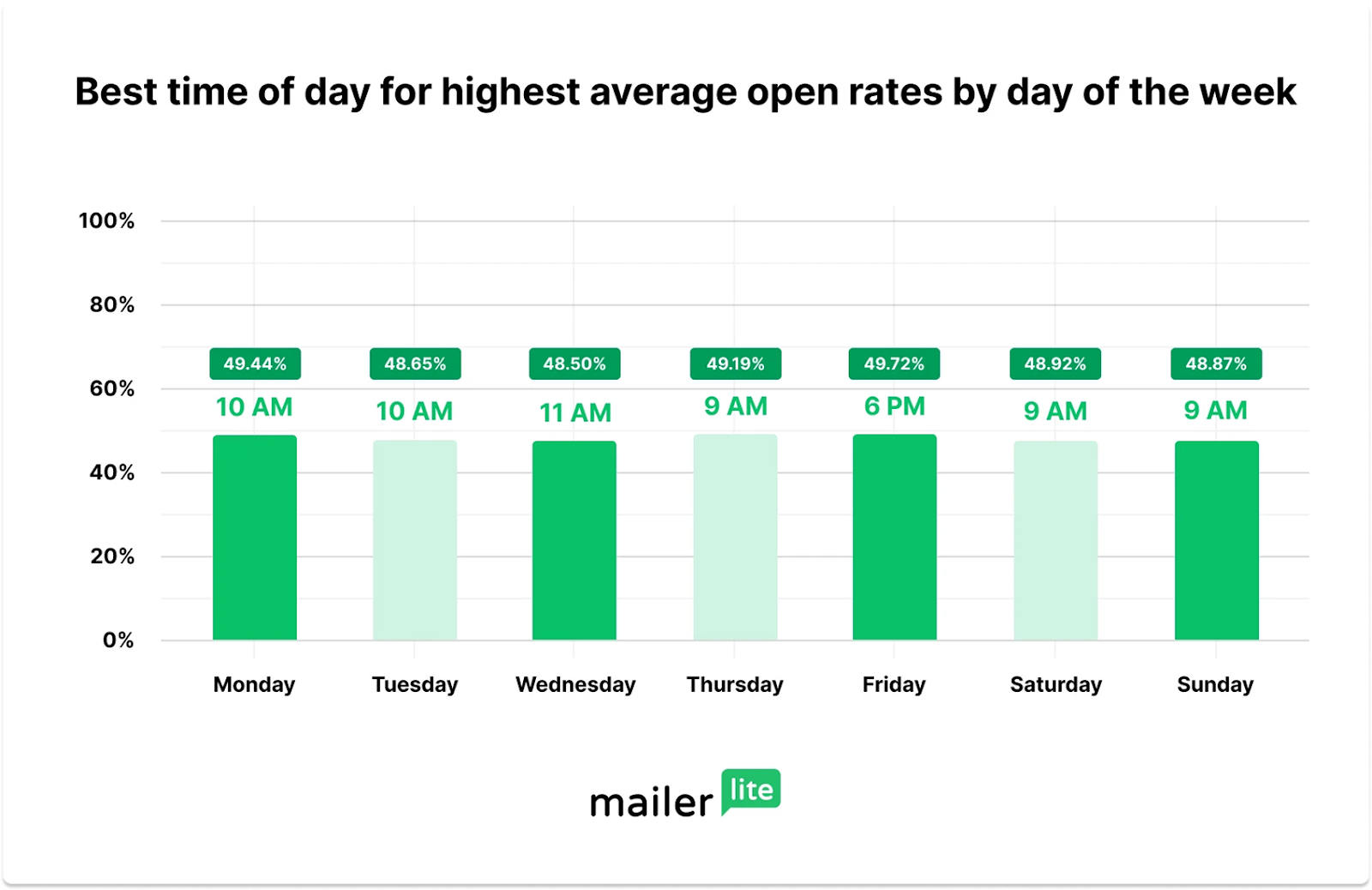
Thursday and Friday see the most campaigns sent, meaning Friday’s performance holds up despite heavier inbox competition
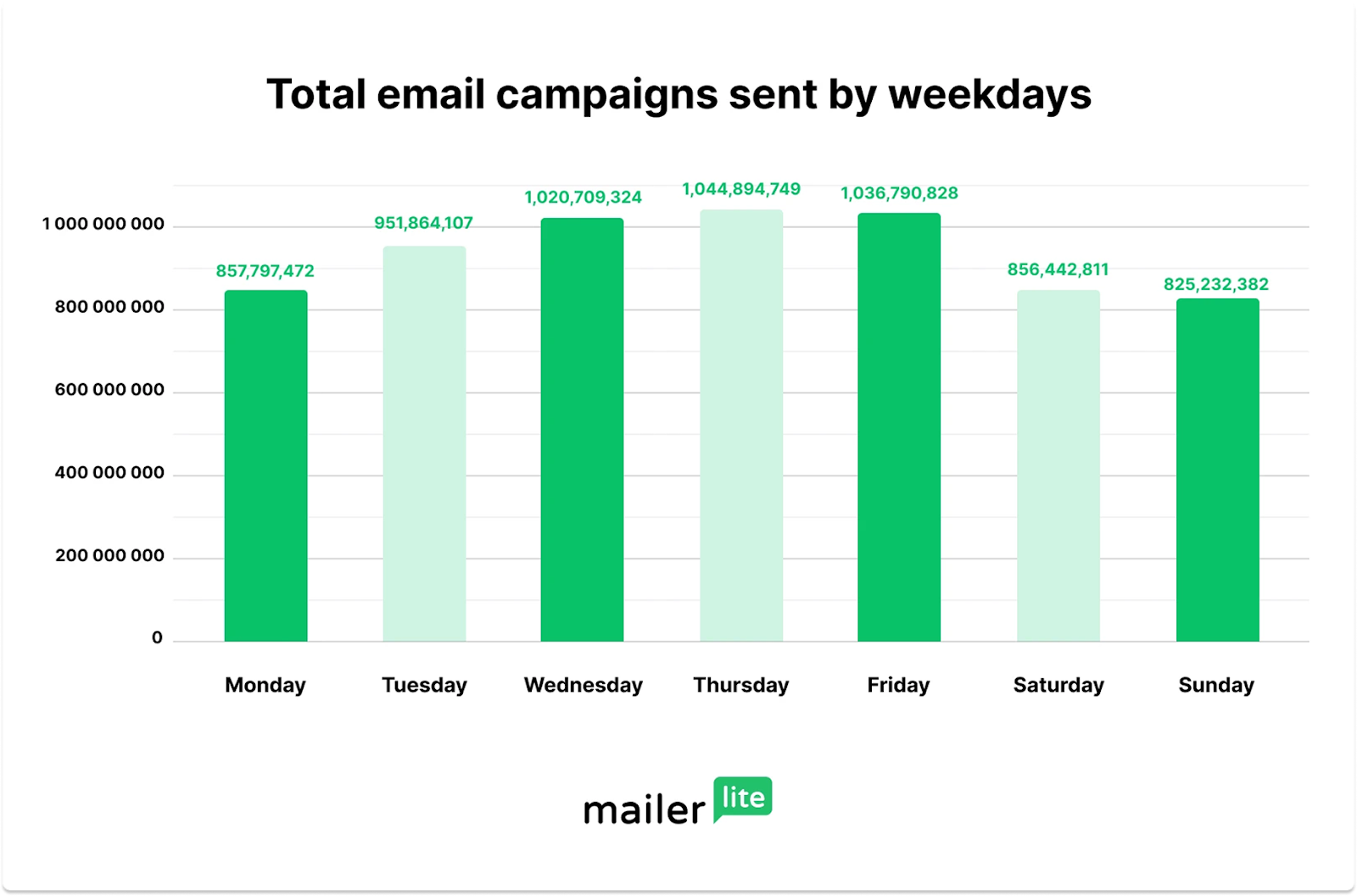
Open rates across all weekdays sit in a narrow band, between 46.5% and 49.7%
The narrow band matters. It means the difference between your best and worst weekday send is smaller than most guides suggest.
What shifts the outcome is not just the day but the combination of day, email type, and audience.
Tuesday remains the most practical default for most campaigns, even with Friday’s strong showing in recent data.
Customer.io’s analysis, drawing on Moosend’s review of 10 billion emails, ranks Tuesday in the top two for open rates alongside Thursday.
The behavioral logic is straightforward: by Tuesday, recipients have cleared Monday’s backlog and settled into their week without end-of-week pressure yet building.
That mental state favors reading, engaging, and acting on email content.
The distinction worth making is between what you want your email to accomplish: use Tuesday for opens, and use Thursday or Friday when you need clicks.
Newsletters and educational content perform well earlier in the week.
Emails that require action, such as webinar signups, purchases, or downloads, tend to do better later in the week when click-through rates climb.
The best send day for B2B is often the wrong send day for B2C, and vice versa.
The fundamental difference is cognitive state. B2B recipients are in task-oriented, efficiency-driven mode during business hours.
B2C recipients are in browsing, leisure-driven mode during evenings and weekends. Same email, different moment, completely different result.
Tuesday, Wednesday, and Thursday are the strongest days for B2B email, and the effective window is tight: 9 to 11 AM and 1 to 3 PM local time.
During those hours, professionals are processing information and making decisions. That mental state aligns well with the content that performs in B2B:
Weekends are nearly always a poor choice for B2B lists.
A well-crafted email arriving on Saturday morning is likely to be buried by Monday’s backlog before anyone sees it.
B2C campaigns perform best in the evenings and on weekends, particularly for leisure, retail, lifestyle, and fashion brands.
The click-through rates peaking between 8 and 9 PM for consumer-focused campaigns. While 8 PM sends reached a 59% open rate, a figure that would be exceptional in any B2B context.
Consumers shop and browse during downtime, not during peak work hours.
A Thursday evening send for a retail brand taps into the mindset of someone winding down and planning their weekend, not a professional clearing their task list.
Want your brand story featured on credible media outlets?
MarketersMEDIA Newswire helps you get the kind of third-party visibility these big brands achieved—through press release distribution to established publications. Get in touch with us today.
The type of email you are sending should shape your timing decision as much as your industry does.
They perform better earlier in the week.
Tuesday and Wednesday give recipients enough mental bandwidth to read longer material without meeting-heavy mornings or end-of-week pressure pulling their attention away.
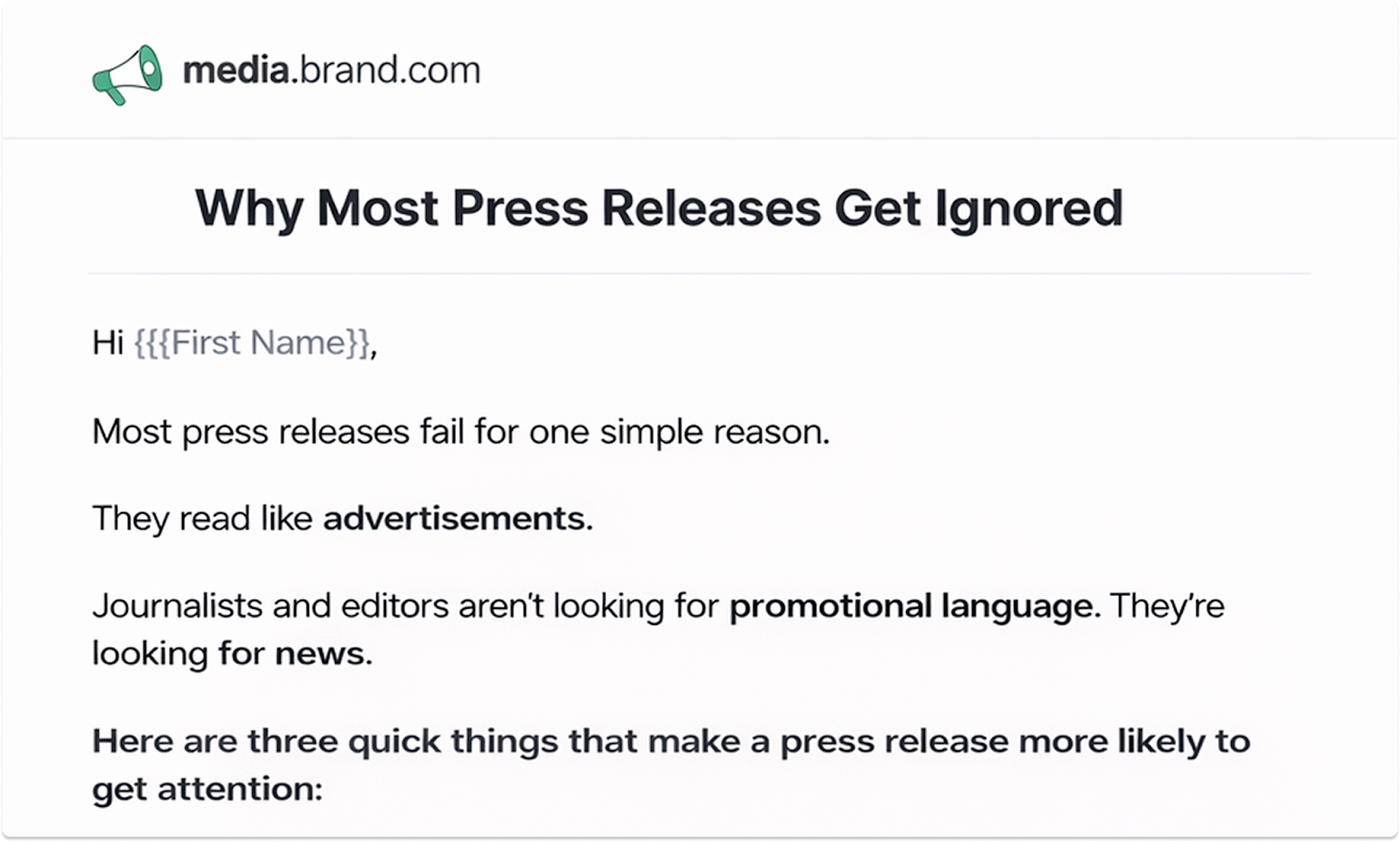
Example of educational email marketing:
These emails work better later in the week.
Thursday and Friday create a shorter window between the send and the weekend, which works in your favor for conversion-oriented campaigns.
A sale expiring Friday evening is better announced Thursday morning than Tuesday.
This type of email targets dormant subscribers who benefit from less competitive send windows.
Tuesday is a high-volume day across most industries.
A Sunday evening or Monday morning send, when fewer campaigns land, can meaningfully improve your visibility in a crowded inbox.
Welcome emails operate outside day-of-week logic entirely.
The engagement window for a new subscriber is highest in the first hour after signup. Automation that fires immediately will always outperform a scheduled send, regardless of what day it falls on.
Time zones directly affect whether your chosen send day performs as expected, particularly for lists with subscribers across multiple regions.
A Thursday 8 AM send to a US-only list is clean and predictable.
The same send to a global list means some recipients receive the email in the middle of the night and others receive it mid-afternoon.
The gap in open rates between those two scenarios has nothing to do with the email itself.
It is recommended to use email marketing platforms with time zone segmentation to deliver campaigns at the most appropriate local time for each recipient.
Most major platforms support this feature. Enabling it is one of the higher-leverage adjustments available without changing a single word of your email.
If your list spans multiple time zones and you are not segmenting by local time, you are likely underperforming on send days that should be producing stronger results.
Saturday and Sunday produce the lowest open and click-through rates across most industries.
The exception is B2C brands in leisure, retail, and lifestyle categories, where weekend sends can compete effectively because consumer browsing peaks during free time.
Monday comes with a specific problem: inbox competition from the weekend backlog.
Recipients are in catch-up mode, processing accumulated messages rather than browsing. Open rates on Monday can look reasonable in aggregate, but conversion-oriented campaigns tend to underperform because the mental state does not favor acting on marketing messages.
Major holidays require their own judgment. B2B senders should generally avoid holiday sends entirely.
For B2C senders, the day before or after a major holiday often outperforms the holiday itself in terms of open and conversion rates.
Industry benchmarks give you a starting hypothesis, not a final answer.
The only send-time study that genuinely applies to your business is the one you run on your own list.
Use one control send time and one variable.
For example, test weekday versus weekend sends, or compare two different time blocks within the same day.
Repeat the same test across at least three to four sends before drawing conclusions. A single campaign result is not enough to identify a reliable pattern.
Most major email platforms now offer AI-powered send-time optimization.
According to Customer.io, this approach can increase open rates by up to 23% compared with static send times by delivering emails based on each subscriber’s behavioral history.
Instead of sending to everyone at the same time, the system sends when each person is most likely to open.
For example, if a subscriber consistently opens emails at 9 AM on Thursdays, the email will be delivered at that exact time for that individual.
The best send day is the one confirmed by your own audience data.
Industry averages smooth out the differences that matter most at the individual subscriber level.
The right send day depends on your email type, your audience, and your campaign goal. Here is the short version:
Timing is one of the variables in email marketing that costs nothing to change.
The content stays the same regardless of when you send it. Getting the send day right means your existing emails reach your audience when they are most likely to open, read, and act.
Start with Tuesday or Friday as your baseline depending on your email type. Test over three to four sends before committing to a schedule. Then let your own data lead.
Getting your email timing right is one part of a broader content distribution strategy. If press release distribution is part of your marketing mix, MarketersMEDIA Newswire gets your brand in front of over 2,000 media endpoints, including AP News, Yahoo News, and Business Insider.
Contact our team to find out how press release distribution fits alongside your email and content calendar.
A: Yes. Different industries see different peak engagement days based on how their audience spends their time. Retail and lifestyle brands often outperform on evenings and weekends when consumers are browsing, while B2B-focused industries consistently see stronger results on Tuesday through Thursday during business hours.
A: Tuesday and Thursday are the most commonly recommended days for cold outreach. By Tuesday, recipients have cleared Monday’s backlog and are more likely to engage with new senders. Friday is too close to the end of the week for a cold email to prompt a meaningful response before the weekend.
A: Consistency helps for newsletters and regular content emails. Subscribers who expect your email at a specific time are more likely to look for it. For one-off promotional campaigns, timing the send to match the subscriber’s likely mental state matters more than maintaining a fixed schedule.
A: Run the same test across at least three to four sends before drawing conclusions, and make sure each test variant has a large enough sample to be statistically meaningful. A single campaign is not enough to identify a pattern. Look for consistency in open rates and click-through rates across multiple sends before making permanent changes to your schedule.
A: Yes. A strong subject line can compensate for a suboptimal send time by earning an open regardless of when the email arrives. A weak subject line sent at the optimal time will still underperform. Send day timing improves the conditions for engagement but does not replace strong copy.


 PR playbook to get your brand cited in AI answer
How to check and fix what AI says about your brand
2 minutes checklist to make your PR AI-friendly
PR playbook to get your brand cited in AI answer
How to check and fix what AI says about your brand
2 minutes checklist to make your PR AI-friendly