New Media Unlocked!
You can now publish on USA TODAY through MarketersMEDIA. That's 142M+ monthly visitors and DR 92 backlinks for every release you publish.
Better reach, better SEO, better credibility.

You can now publish on USA TODAY through MarketersMEDIA. That's 142M+ monthly visitors and DR 92 backlinks for every release you publish.
Better reach, better SEO, better credibility.
Table of Content


We’re starting to say ‘Try ChatGPT-ing it’ more often instead of ‘Try Googling it’, right? People are no longer relying on a single search box to find information.

Today, questions about brands, products, and industries are increasingly answered by AI tools such as ChatGPT, Google’s AI Overviews, and other conversational search platforms.
Research shows that 37% of consumers begin searching for information using AI tools rather than traditional search engines. This shift is driven by the fact that AI provides:
This figure is expected to rise in the coming years. In the U.S. alone, the number of adults using AI for online search is projected to surpass 36 million by 2028.

That creates a new challenge for brands because it is no longer only about who gets the click, but who AI chooses to mention when it answers users’ questions.
So, let’s be real. When you ask ChatGPT or Gemini about your industry, does your brand come up at all?
If it does not, AI is still answering the question. It is just answering it without you.
That usually means:
And most brands do not realize this is happening until they check for themselves.
But, why does this happen?
The reason is, if AI has not picked up enough trusted signals about your brand, it has nothing solid to reference. No context. No confirmation. No reason to include you.
So let’s look at how you can make sure your brand actually appears in AI search results.
AI systems prefer information that is:
For AI, structured information reduces uncertainty. The clearer the structure, the less interpretation AI has to do, and the more confident it can be when reusing the information.
That is exactly why press releases work so well.
Press releases are designed to answer the same core questions every time:
This matters because AI systems are built to extract entities and relationships. When those facts are clearly stated instead of implied, AI does not have to infer meaning or guess context.
It can identify the brand, understand what happened, and connect it to the right topic with far less risk of misinterpretation.
Press releases follow a predictable format:
For reference, you can check out our free press release templates that use this structure.
This consistency acts like a map for AI. It helps the system distinguish between what is factual, what is contextual, and what is background information about the brand.
With this structure, it means less ambiguity for AI.
Less ambiguity means less risk. And when there is less risk, AI is more willing to reference the content.
AI search engines favor informational content over persuasive copy. Press releases are typically written in a neutral, announcement-style tone, which makes them safer to summarize and reuse.
Sales-heavy language introduces uncertainty. Claims sound subjective. Promises are harder to verify. That makes AI more likely to skip the content entirely or dilute it into generic explanations.
Press releases, by design, avoid that problem. They state what happened, not why you are the best.
Press releases are usually published as standalone pages, clearly dated, and archived long-term.
This will help AI to revisit information repeatedly as it updates its understanding of brands and industries. Content that disappears, changes frequently, or lacks clear timestamps is harder to rely on.
When press releases are published through established media environments, they also benefit from stable archives and consistent formatting. That gives AI a reliable reference point it can return to again and again.
The result is simple.
When information is structured, factual, and easy to revisit, AI is more likely to find it, trust it, and reuse it when answering questions about your brand or industry.
For brands that only exist on their own websites or in isolated channels, it will be harder for them to be recognized by AI because there is no outside validation.
That information is considered as self-reported and, from an AI perspective, unverified.
AI will start asking:
If those questions remain unanswered, AI will play it safe and will skip the information from the sources that they feel like less credible.

But, when the same brand appears on independent and credible sites such as Business Insider and AP News, those mentions reinforce each other and build confidence. These established publishers come with history. They have published millions of factual, news-style articles over time.
So, from AI’s point of view, a third party decides that the information is worth publishing and it will start to think, “This information was published by a credible source, so it’s probably safe to be treated as reference.”
AI systems learn from that consistency. They associate these sources with structured information, real entities, and verifiable events.
So when your brand appears there, AI treats it differently. The content about your brand will be deemed as:
And when AI feels confident, it includes you.
One single appearance is barely enough to help you build your brand visibility on AI search engines. It develops when the same information shows up repeatedly across different, independent publications.
The key is consistency.
When your brand appears consistently across multiple media outlets, it strengthens the presence of:
The information becomes easier for AI to recall and reference when related questions come up.
It will make the AI feel like; “Okay, this keeps showing up on different trusted sites, and they’re all saying the same thing. This looks legit.”
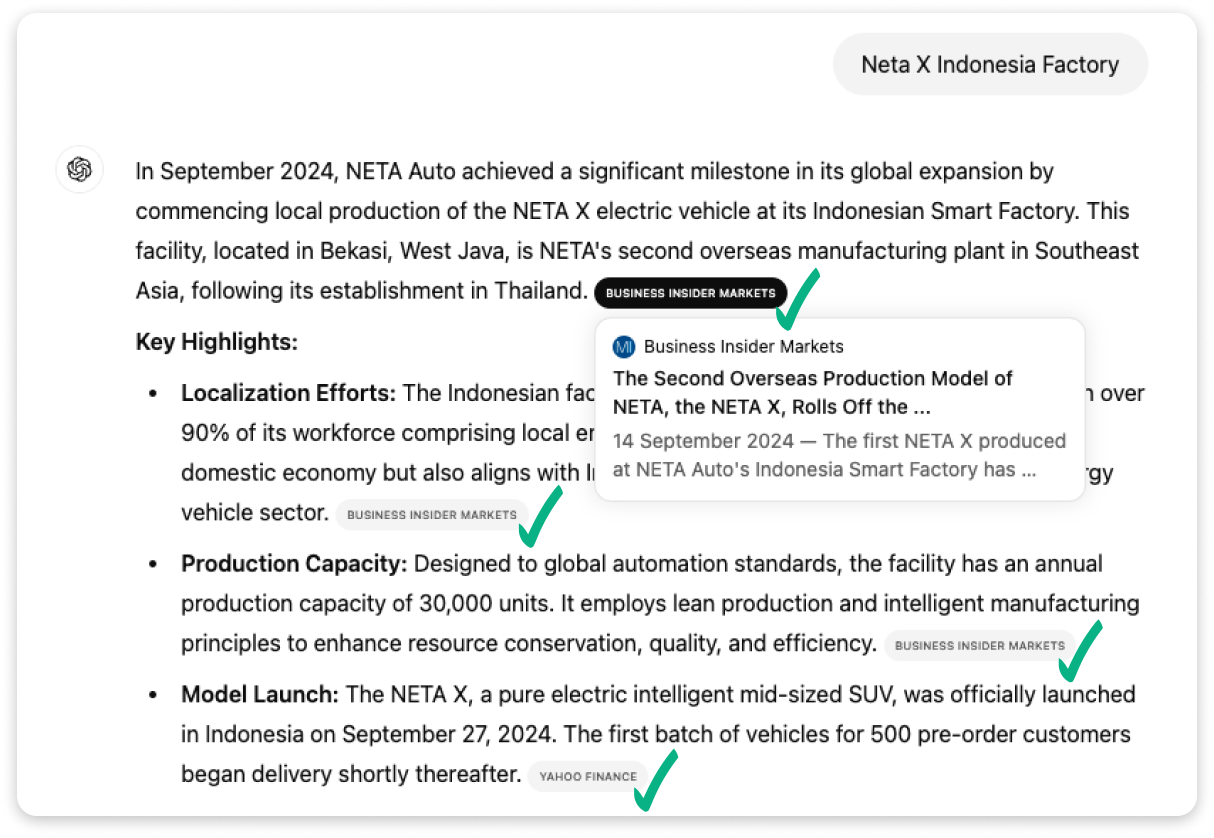
For example, when NETA Auto expanded its global operations by launching a new production facility in Indonesia, the announcement appeared across multiple established publications, including Yahoo Finance and Business Insider.
The result? AI-powered search results started showing the brand and its expansion, because the information showed up in the right places and in a format AI could work with.
It happened because the press release was distributed in a way that created consistent, credible signals across trusted media.
This is where MarketersMEDIA Newswire plays a practical role.
By distributing press releases across multiple trusted and independent media outlets, MarketersMEDIA helps brands create a consistent third-party presence that AI systems rely on to:
As you can see, the pattern is clear. By combining these three elements:
You create the foundation for AI visibility that builds over time.
That is why some brands start appearing in AI answers while others stay invisible. Instead of being the loudest, they are being consistently present in the places AI already trusts.
Free Press Release Template
Get your free copy of press release template and advanced PR guide to run your press release.

AI-powered search is not something that is coming later. It is already shaping how people find brands, compare options, and make decisions.
The real question is simple.
When someone asks AI about your industry, will your brand be part of the answer? So, if you’re ready to build real AI visibility for your brand, MarketersMEDIA can help you get there. Get in touch with us today.


 PR playbook to get your brand cited in AI answer
How to check and fix what AI says about your brand
2 minutes checklist to make your PR AI-friendly
PR playbook to get your brand cited in AI answer
How to check and fix what AI says about your brand
2 minutes checklist to make your PR AI-friendly