New Media Unlocked!
You can now publish on USA TODAY through MarketersMEDIA. That's 142M+ monthly visitors and DR 92 backlinks for every release you publish.
Better reach, better SEO, better credibility.

You can now publish on USA TODAY through MarketersMEDIA. That's 142M+ monthly visitors and DR 92 backlinks for every release you publish.
Better reach, better SEO, better credibility.
Table of Content


You submit a press release. You pitch a journalist. Nothing comes back. You wonder whether you are even on anyone’s radar.
That feeling usually comes down to one problem: you are not on the right PR list yet, and nobody is going to put you on one by accident.
A PR list is a database of contacts that journalists, editors, and brands use to decide who gets pitched, sourced, and featured.
Being on one means you are in the room when opportunities get handed out. Not being on one means you are starting from zero every single time.
The good news is that getting on these lists is a learnable, repeatable process.
It requires the right presence, the right contacts, and the right outreach. This post covers all three.
A PR list is not a single thing. The term gets used loosely, and mixing up the two main types leads to wasted effort.
This is what businesses and PR professionals are usually after.
A media relations contact list is a curated database that journalists, editors, producers, and bloggers use to track sources, and that PR teams build to target press outreach.
Being on one means you are in the consideration set when a reporter needs a comment, a source, or a story.
These are maintained by brands and agencies.
They contain influencers, content creators, and bloggers who receive early product access, PR packages, and campaign invitations.
Getting on these lists is about demonstrating content fit and audience alignment, not editorial credibility.
The mistake most guides make is treating these as the same goal.
They are not. A business owner wanting coverage in Business Insider needs a very different strategy than a beauty creator trying to receive skincare samples.
Not every list carries the same weight. Understanding the landscape helps you prioritize where to spend your effort.
Journalists also build their own contact lists of sources they trust.
Getting on both matters. One gets your press releases in front of reporters. The other puts your name in a journalist’s notes when they need a quote or a story angle.
Brand marketing teams and PR agencies maintain these to manage product seeding and campaign outreach.
They are especially common in consumer goods, beauty, fashion, and technology.
Most brands add creators who have already organically mentioned their products and demonstrated genuine audience engagement.
Trade publications, research firms, and business media maintain lists of go-to experts for their beat.
Getting onto these lists typically means publishing consistently, speaking at industry events, and being quoted in other outlets first.
This is digital PR at its most compound, where each placement earns the next one.
High-value influencers, senior journalists, and industry insiders often land on a separate tier.
These lists are invite-only and driven almost entirely by reach, relevance, and existing relationships. Most people earn their way there after spending time on the standard lists first.
Nobody puts you on a PR list based on potential. They put you there based on what they can already see.
For businesses and brands, this means building a credibility footprint that holds up under a five-minute search.
A journalist or PR manager who receives your pitch will check your website, scan recent press coverage, and look at how you talk about your industry.
What they find either opens the door or closes it.
Practical steps to build that presence:
For content creators, the equivalent is building an engaged audience with a clear niche. 60% higher campaign engagement rates are driven by micro-influencers compared to macro-scale accounts, which is why brands increasingly prioritize authentic engagement over raw follower counts.
The chart below shows how the key performance signals compare across the PR landscape:
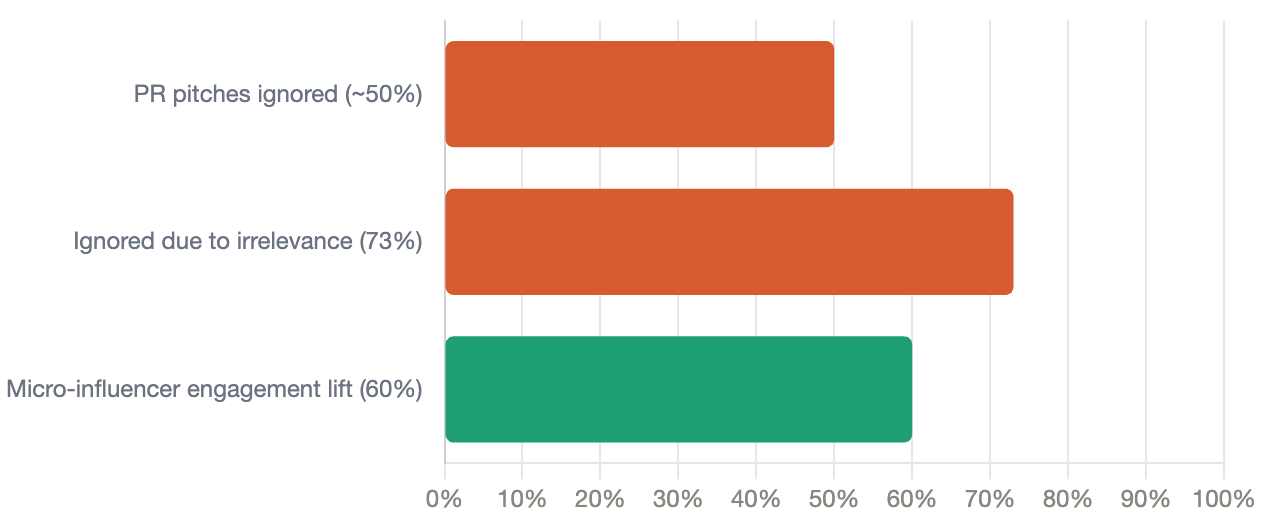
Relevance is the dominant issue. Getting noticed is not about volume of outreach. It is about showing up in the right place, with the right message, for the right person.
Strategies for getting more media coverage consistently over time reinforce this point: presence is built incrementally, not in a single campaign push.
Sending a pitch without knowing who you are sending it to is the fastest way to end up in the deleted folder.
The goal is to build a targeted, verified contact list before you send a single email. Here is how to do it systematically.
Identify five to ten outlets that reach your target audience.
Look at who has been covering companies like yours, search for your competitors’ recent press mentions, and note the journalists writing those pieces.
Those reporters cover your beat by definition.
Media databases like Muck Rack, Cision, and Prowly pull journalist contact details, beat descriptions, and recent articles into a searchable format.
LinkedIn works well for finding freelancers who write for multiple high-profile outlets and are often more accessible than staff reporters.
Twitter and social search using terms like “tech journalist” or “#journorequest” surface active contacts fast.
Brand marketing teams who manage influencer PR lists often list a submissions email or a partnership contact on their website.
A direct, well-written email to that contact is more effective than searching for a workaround.
Not every contact deserves the same level of outreach intensity.
Group your list into three tiers:
This structure helps you allocate effort and decide where to offer exclusives.
Knowing what to include in a media kit before you reach out makes the process significantly smoother.
A well-prepared kit removes the friction from any journalist or brand contact who wants to learn more after your initial pitch.

Use press releases to get your brand mentioned and recommended by ChatGPT, Gemini, and Perplexity when people search.
 PR playbook to get your brand cited in AI answersHow to check and fix what AI says about your brand2 minutes checklist to make your PR AI-friendly
Where would you like to receive the AI PR toolkit:
Most pitches fail before they are read.
The subject line is generic, the opening paragraph talks about the sender rather than the story, and there is no obvious reason why this particular journalist should care.
A strong pitch has four components:
The pitch should be short enough to read in under sixty seconds. If it takes longer, it loses.
Personalization is not optional. Nearly half of all PR pitches are ignored primarily because of lack of relevance.
Referencing a recent article the journalist published, or connecting your story to something they have expressed interest in, is the clearest signal that you did your research and are not mass-blasting a list.
Knowing how to pitch your story to journalists with a clear angle and tight copy is a skill that compounds over time. Every successful pitch builds a relationship that makes the next one easier.
An example of what the message structure might look like, for a tech company pitching a reporter who covers startup funding:
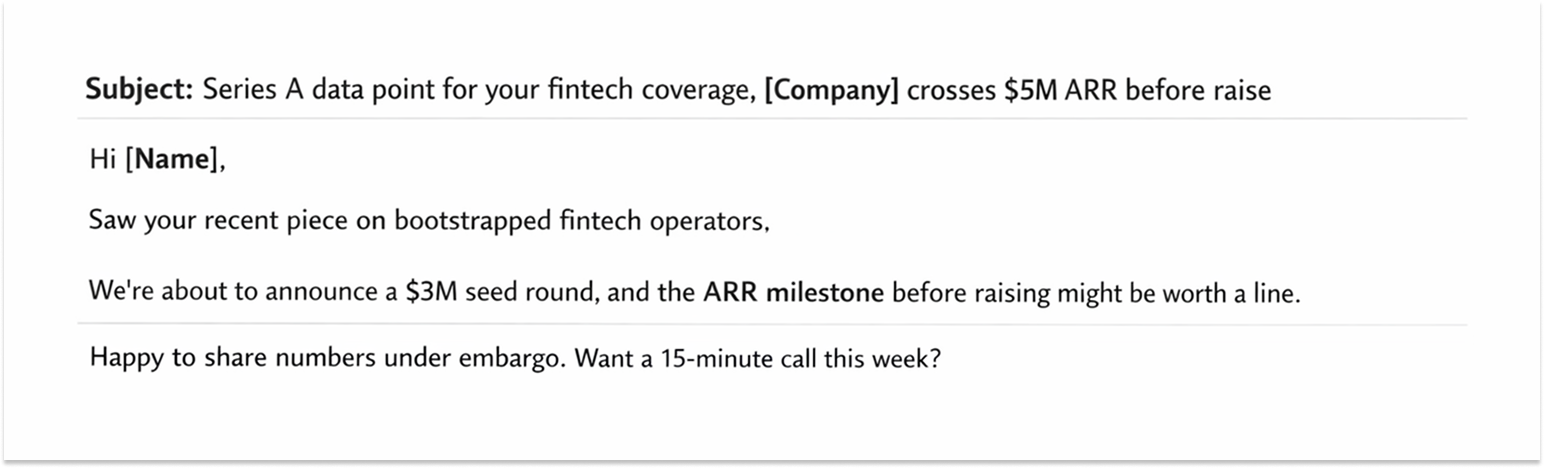
Short. Specific. Gives the journalist a reason to say yes.
Press releases are often framed as something you send after you are already on a journalist’s list. In reality, they are one of the most effective tools for getting onto that list in the first place.
When a reporter researches a company before reaching out, they check Google News, media archives, and established news domains.
A press release distributed to outlets like AP News, Business Insider, Yahoo Finance, USA Today and Nasdaq gives your brand a verifiable public record on the exact platforms journalists trust as credible sources.
That record is doing quiet work before any direct outreach begins.
Distribution through a structured newswire service means your announcement lands on indexed, archivable news domains. Those placements are picked up by search engines, referenced by AI tools, and visible to any reporter running a basic search on your company or your industry.
Want your brand story featured on credible media outlets?
MarketersMEDIA Newswire helps you get the kind of third-party visibility these big brands achieved—through press release distribution to established publications. Get in touch with us today.
Understanding how to distribute press releases for maximum impact is worth the time investment. The outlet mix, timing, and editorial quality all affect how much traction each release earns.
A published press release visible across major media platforms signals that your brand is active, newsworthy, and verifiable.
For example, established brands such as Tesla often appear in news headlines, which helps maintain ongoing visibility.

Getting on a PR list is not complicated, but a few consistent errors keep brands out of consideration even when their story is genuinely worth covering.
Sending the same email to two hundred journalists with no personalization reads as spam.
Journalists talk to each other, and a reputation for mass-blasting is hard to reverse. Targeted, relevant outreach to a smaller list consistently outperforms volume-based approaches.
A fashion editor receiving a press release about enterprise software is not going to cover it.
Neither is a tech journalist being pitched a local restaurant opening. Mismatched pitches do not just get ignored, they damage your credibility with that contact permanently.
A journalist who receives your pitch and then finds no press page, no published content, and no previous media coverage has no reason to take the outreach seriously.
The pitch is only as strong as the presence behind it.
Most successful media placements involve at least one follow-up.
Sending a single pitch and waiting is not a strategy.
A brief, polite follow-up three to five business days later is standard practice and frequently makes the difference.
Journalists change beats and outlets frequently.
A media list that is never updated becomes a liability. Bounced emails damage sender reputation and can get your domain flagged as spam, which makes every future outreach harder.
Avoiding these errors is covered in detail across a range of proven PR tactics that consistently improve media pickup rates.
The fundamentals have not changed: relevance, timing, and a credible presence behind every pitch.
Getting on a PR list, whether a journalist media list or a brand’s influencer list, is an active process, not a passive one.
It starts with building a presence that gives people a reason to include you. It continues with targeted, personalized outreach to the right contacts.
And it is reinforced by consistent distribution of credible, newsworthy content across established media domains.
If you are looking to build that media footprint efficiently, MarketersMEDIA Newswire offers press release distribution across a verified network of outlets including AP News, Business Insider, Yahoo Finance, USA Today, and Nasdaq.
Each published release becomes part of a searchable, archivable public record that works for your brand long after the initial distribution date.
Start building your media presence today, explore distribution options at MarketersMEDIA Newswire.
A: A media list refers specifically to a database of journalists, editors, and reporters used for press release distribution and story pitching. A PR list is a broader term that can include influencers, industry analysts, bloggers, and non-traditional media contacts. In practice, the terms are often used interchangeably, but the goal, and the strategy, differs depending on whether you are targeting editorial coverage or brand partnerships.
A: Building relationships with journalists and getting onto their sourcing lists typically takes three to six months of consistent, relevant outreach and public presence. Immediate inclusion is possible through newswire distribution, which puts your content on the established media domains journalists actively monitor. The two approaches work best in parallel.
A: Not necessarily. Brands increasingly prioritize engagement rate and niche relevance over raw follower count. Micro-influencers with highly engaged audiences in a specific category are often more attractive to brands than large accounts with low interaction rates. A focused, authentic content presence in a relevant niche is more important than scale.
A: A media kit for journalist or brand outreach should include a company or personal bio, high-resolution images, key statistics or audience data, examples of previous coverage or content, a brief overview of products or services, and a direct media contact. For influencers, this typically also includes engagement metrics and platform reach broken down by channel.
A: Yes. Press releases distributed through established newswire services create a public media record on indexed news domains that journalists reference when researching companies. Consistent distribution builds a verifiable presence across outlets like AP News, Business Insider, and Yahoo Finance, which increases the likelihood of appearing on journalist sourcing lists and in AI-generated search results over time.


 PR playbook to get your brand cited in AI answer
How to check and fix what AI says about your brand
2 minutes checklist to make your PR AI-friendly
PR playbook to get your brand cited in AI answer
How to check and fix what AI says about your brand
2 minutes checklist to make your PR AI-friendly